FISHING RESEARCH, EXPLAINED

Fishing studies and water records, explained.

What would support a claim about a hook, a tide correction or a better month to fish? Start with what was counted or measured, then read the comparison and its limits. Some pages explain published fish studies; others analyze existing public water or fishing records.

Choose a question and follow the explanation from the unfamiliar terms to the finding. Each page keeps the source, place, period and unanswered questions beside the result, so you can judge what it tells you about another fishing situation.

RECORDSCOMPARISONFINDING

Ask a question → compare records → explain the finding

11study explanations and record comparisons
03topic groups

A historical measurement, a published experiment and a review of several papers offer different kinds of evidence. Read the page’s method to see which one you are using.

PICK A QUESTION

Choose a question, then inspect the evidence.

These three introductions show different comparisons: a calculation on later records, catches alongside fishing time, and release outcomes measured in different ways. Each works as a starting point on its own.

ONE QUESTION, WITH AN EXAMPLE

Was the water as high as the tide prediction said?

A tide prediction estimates the rise and fall of the water caused mainly by the moon and sun. A water-level station measures the actual height. At Grand Isle in 2025, the gap between those two numbers changed through the year.

Read the upper chart to compare monthly average predicted and measured heights. The lower chart subtracts the prediction from the measurement: above zero means measured water was higher, below zero means it was lower. Both use the same reference level, the zero from which heights are measured.

Positive and negative gaps can cancel in an average. In a made-up pair, a one-foot gap above and a one-foot gap below give a signed average of zero, even though neither prediction matched. The linked analysis also explains absolute differences, which count the size of each gap without its sign.

This is a comparison of height at one station in one year. It does not supply bottom depth, nearby current speed or an adjustment to today’s tide prediction.

Read the explanation and results →
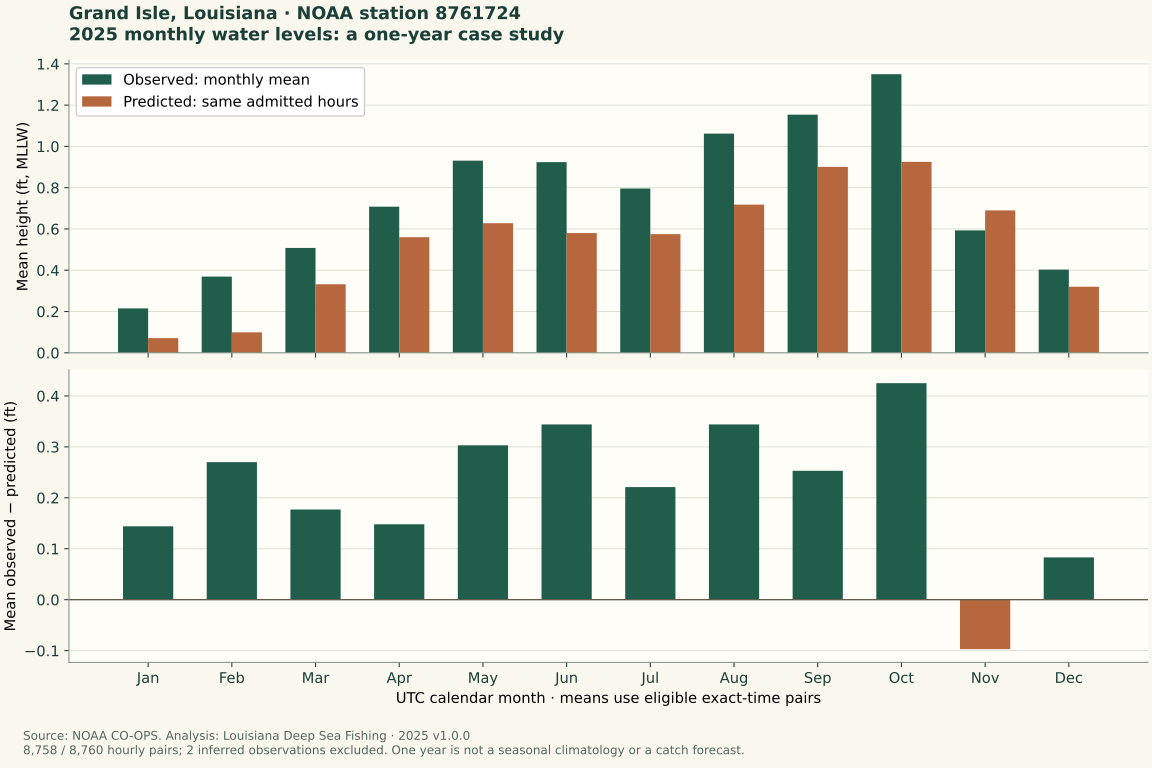
Two panels for 2025 at Grand Isle: monthly measured and predicted water heights above, and their average difference below, in feet.
Historical measurements from NOAA, the federal ocean and atmosphere agency, at station 8761724. This site compared the records. Open the full-size chart · Monthly rows for a spreadsheet (CSV)

4 STUDIES AND COMPARISONS

Water, weather and changing conditions

Compare station heights, weather calculations, saltiness and oxygen records. Keep the location, period and measured quantity with the result.

WATER HEIGHT · GRAND ISLE · 2025

Tide predictions and measured water at Grand Isle in 2025

Compare predicted and measured heights at one station, then learn why monthly signed gaps and the size of errors answer different questions.

Read the study explanation →

WEATHER CALCULATION · GRAND ISLE · 2025

Can wind help correct a tide prediction? Grand Isle, 2025

Follow a weather-based correction from earlier fitting records to later months kept separate, and see why fitting well is not the same as improving the later result.

Read the study explanation →

SALTINESS · TWO SITES · 2019

What happened to salinity after a 2019 spillway opening?

Compare saltiness before, during and after a spillway opening at two stations, keeping the timing comparison separate from proof of a cause.

Read the study explanation →

LOW OXYGEN · GULF RECORDS AND FISH STUDIES

Low oxygen in the Gulf: what it means for fish

Connect low-oxygen habitat with survey areas, measured points and fish studies without treating records from different times as one current reef report.

Read the study explanation →

6 STUDIES AND COMPARISONS

Fish, habitats and fishing outcomes

Investigate hooks, release, reefs, cold and fishing dates. Ask which fish were followed and whether the outcome was a catch, tag return, movement or survival measure.

HOOK SHAPES · PUBLISHED REDFISH STUDIES

What redfish studies tell us about circle hooks

Read what the hook comparisons measured, including deep hooking and follow-up, and which differences limit applying the result to another setup.

Read the study explanation →

MOON PHASE · PUBLISHED CATCH RECORDS

Can moon phase help you choose a fishing day?

Compare fish catches alongside time spent fishing and method before interpreting a relationship with moon phase.

Read the study explanation →

REEF HABITAT · TWO GULF CASES

Do artificial reefs add fish or bring fish together?

Separate fish gathering at a reef from the larger question of whether the habitat added fish to the wider Gulf population.

Read the study explanation →

RELEASE METHODS · PUBLISHED FISH STUDIES

What do studies tell us about releasing red snapper at depth?

Compare release methods and follow-up measures, including tag returns and tracking, rather than treating every fish seen leaving as a measured survivor.

Read the study explanation →

COLD WATER · FISH RESEARCH & JANUARY 2025

How cold water affects speckled trout

Distinguish the lowest temperature, time spent cold and measured fish outcomes using station records alongside published research.

Read the study explanation →

SEASONS · SURVEY ESTIMATES · 2014–2025

What Louisiana's seasonal records tell us about yellowfin fishing

Learn what landings and fishing-effort estimates count, then compare seasonal ratios while keeping the missing winter groups visible.

Read the study explanation →

1 STUDIES AND COMPARISONS

Fishing rules and management history

Read a historical evaluation of a size rule, separating fish measurements, angler interviews and later policy questions.

BASS SIZE RULE · HISTORICAL AGENCY EVALUATION

Did the Atchafalaya's old bass size limit produce more large fish?

Read how an agency evaluated an earlier size rule and why that evaluation does not answer the later policy’s population question.

Read the study explanation →

MAKE SENSE OF A FINDING

Match the conclusion to the measurement.

If a report counts more fish around one moon phase, ask how many people fished and for how long. Fishing effort is the amount of fishing represented, such as trips or hours. Comparing catches with effort asks a different question from adding up catches alone; neither automatically proves what caused a difference.

Our pages use existing public records and published studies. They do not claim that we caught or tracked the fish ourselves. Look for the place, dates, number of fish or records, and information that was missing. Those details help you judge whether a finding applies to another place, date or fishing method.

Charts and downloads are there for a closer look. A CSV file opens as spreadsheet rows; JSON is a labeled record format used by software. A review of published papers may compare their reported group results without having the original record for every fish.

Look up an unfamiliar fishing or study word →
Record
A saved measurement or observation, such as water height at a particular time or what happened to a tagged fish.
Comparison
Looking at groups or periods together. Check whether the conditions and the way results were counted were similar enough.
Uncertainty
What we don’t know about the size or explanation of a result. A small group, missing records or several possible causes can leave the answer less settled.
Source and method
The source tells you where information came from. The method explains how it was collected or compared, so someone else can examine the work.

KEEP A FINDING IN CONTEXT

Make a three-part reading note.

Write what was measured and compared; the place, period and source; and the limit that matters for your question. For example, “One station’s historical water heights” preserves more useful context than “the tide table was wrong.”

Then choose the next job. A practical skill needs a technique lesson; a trip date needs the relevant forecast and access; a research claim may need the detailed methods or original source. A study can help you ask a sharper question without answering all three.

Read the available forecasts and water measurements →