Speckled trout are spotted seatrout, a coastal fish. Severe cold can harm them, but a single low temperature doesn't tell the whole story. How cold the water became, how long it stayed cold and where fish could move all matter.
Look at how long the water stayed cold as well as its lowest temperature. We use published fish studies and a January 2025 Grand Isle water record to explain that difference. The water record tells us what one station measured; it does not count fish deaths.
Keep the evidence in three groups while reading: inferred outcomes for tagged field fish, outcomes under specified laboratory trials, and exposure calculated from a station record. They address related questions with different animals, conditions and denominators.
Learn the cold-water words
Exposure means the conditions experienced over time. Duration is how long they lasted. A minimum is the lowest accepted reading, rather than a description of the whole month.
Mortality means deaths. Loss of equilibrium means a fish cannot hold its normal upright position. That is a different observed outcome from death.
A refuge is a place an animal can reach and use that reduces the relevant stress. Deeper water is a possible refuge only if the conditions and connection support that idea, not simply because it is deeper.
What the North Carolina field work found
Researchers tracked adult trout through cold and mild winters, combining sensor detections, relocations and a model of fish outcomes. The colder winters had more inferred natural mortality.
Inferred means worked out from evidence and assumptions, rather than directly observing every death. A tag staying in one place or no longer being detected can have several explanations, including death, movement or a detection gap. The study's rules and differing follow-up periods matter.
Dividing a death count by the initial fish count does not recreate the authors' population mortality model. The detailed table keeps the groups separate. The mild-winter Pungo death was classified as predation, not a cold death. Keep tagged counts, fish considered at risk, follow-up and assigned outcomes with their own groups. Pooling those counts or treating every missing detection as death would change the question rather than reproduce the published result.
What the laboratory information adds
A separate paper described rapid cooling and prolonged exposure as different experiments. Losing normal orientation during one trial and surviving for a period during another don't create a simple ladder of safe and deadly temperatures.
The original review had the laboratory paper's published abstract, not its complete final methods. It therefore does not publish invented trial denominators or survival percentages. The reported salinity effects also don't justify a rule that saltier water is always a refuge. Read each reported outcome with its cooling or exposure design. An orientation response in one experiment and survival in another are not interchangeable endpoints, and abstract-only coverage leaves methods and denominators unresolved.
The January 2025 Grand Isle example
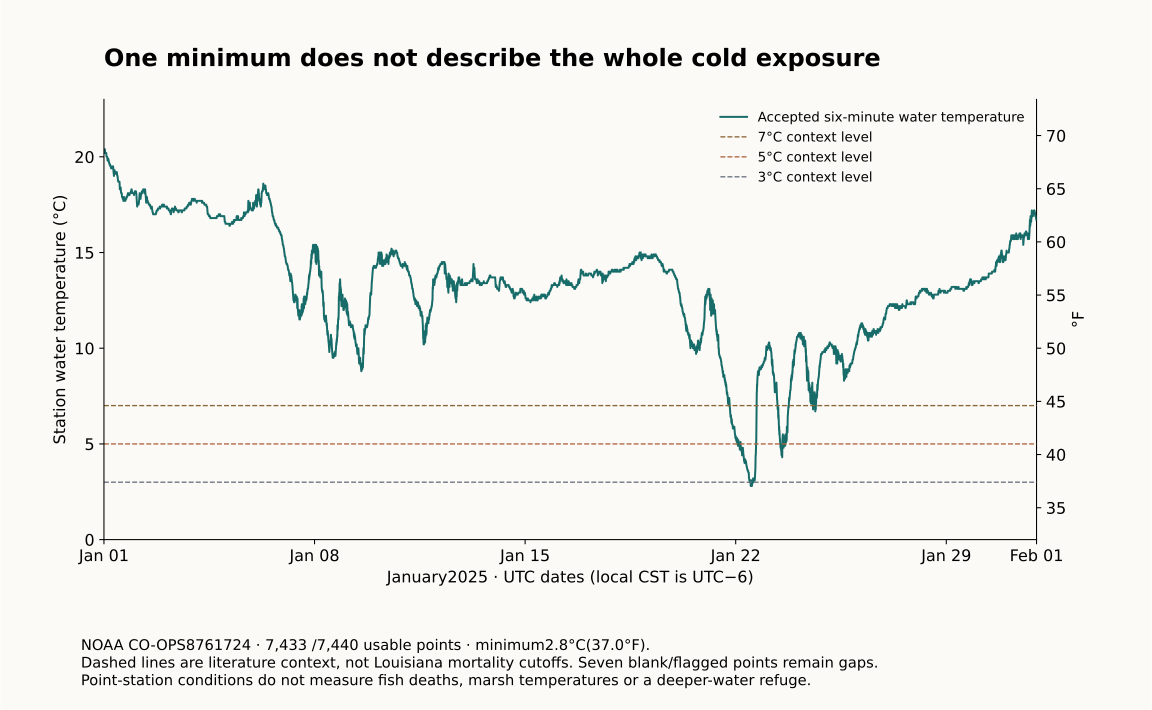
The complete month had 7,440 expected six-minute slots. Seven blank, flagged readings were excluded, leaving 7,433 usable observations.
The accepted minimum was 2.8°C, about 37.0°F. The record contained 16.2 sampled hours below 5°C (41°F), with a longest consecutive sampled run of 12.4 hours. Each accepted observation represents a six-minute block, or bin. The calculation counts those blocks; it doesn't locate the exact instant the water crossed the reference temperature between readings.
Those numbers answer different questions: the lowest reading, total sampled time below a reference level and the longest run. The 3°C, 5°C and 7°C summaries overlap: a reading below the coldest level is also below the warmer ones. Their hours must not be added. They are research reference levels, not newly validated Louisiana lethal thresholds.
The retained threshold summary keeps total sampled hours, longest sampled run and the exposure index under separate labels. The run resets at a missing or flagged reading, or a reading at or above the reference level; missing periods are not bridged into a confirmed continuous spell. These remain sampled-bin summaries, not exact crossing times or a reconstructed temperature history for individual fish.
The National Oceanic and Atmospheric Administration, or NOAA, collected the record. This site screened and summarized it. The sensor's historical January mounting was not independently confirmed, and one point doesn't show all depths or fish locations.
What this means for a winter outing
Keep a water-temperature reading with its place, time, depth and measuring method, and look at earlier and later observations. An air forecast and water temperature are different information. Preserve the timestamp and coverage when comparing a recent reading with a colder period; don't substitute an air minimum for the station's water record or turn a point reading into conditions across all marsh depths.
To investigate a deeper refuge, you would need appropriate temperature measurements at the different depths, a usable connection and evidence that fish use it. A deeper channel isn't automatically measured warm shelter.
If fish appear distressed, leave them undisturbed and use the Louisiana Department of Wildlife and Fisheries’ fish-kill reporting guidance. Don't use a study threshold to justify fishing a concentration of stressed animals.
Louisiana tracking and fish-kill reports provide additional context, but the original review had only the dissertation abstract and could not retrieve the full preliminary kill assessment. It does not invent a statewide kill count.
Keep unavailable full methods and unconfirmed historical sensor mounting visible as evidence gaps rather than fill them with a convenient assumption. Numerical screening and reproducible exposure summaries are separate from independent fisheries/statistical review, which remains pending.
This is a focused review and station analysis, not a mortality warning system. The speckled-trout guide introduces the fish and the ordinary fishing activity.