Moon phase is the changing appearance of the moon's lit side during the month. Fishing calendars sometimes use it to suggest good dates or feeding times. This review asks whether published fishing results support one simple answer.
The relationship varied with the fish and fishing method. The reviewed evidence does not establish one best moon for Louisiana fishing or a proven redfish bite score. Moon information can be context while you choose a workable place, forecast and activity.
Read a calendar claim as a specific question: which fish, fishing method, effort measure, place and period does it describe? A pattern in one fishery and a prediction for a daily feeding window are different claims.
Count the fishing effort too
Ten fish caught during ten hours and ten fish during one hour are different records. Effort is the fishing used to produce the catch: hours, trips or deployed hooks, for example.
Catch per unit effort, shortened to CPUE, divides a catch by a stated amount of effort. That amount is the denominator. Fish per hour and fish per thousand hooks are different measures.
A phase with more trips can produce more total fish without better results per hour. Leaving unsuccessful trips out makes the comparison less useful too. A catch rate is not a count of all fish present, or a beginner's chance of success. Keep the effort definition with every rate; hours, angler-hours, trips and hooks cannot be compared as though the denominator were the same.
What the Gulf study compared
The 2017 Gulf reef-fish lunar paper used Gulf commercial reef-fishing observations from 2006–2015. Not every species analysis used the full period: missing hook counts and target information limited some comparisons.
The models included effort and several other factors alongside the moon's cycle, also called the lunar cycle. A model is a specified calculation used to describe relationships. An association means values changed together in those records; it doesn't by itself prove the moon caused the catches.
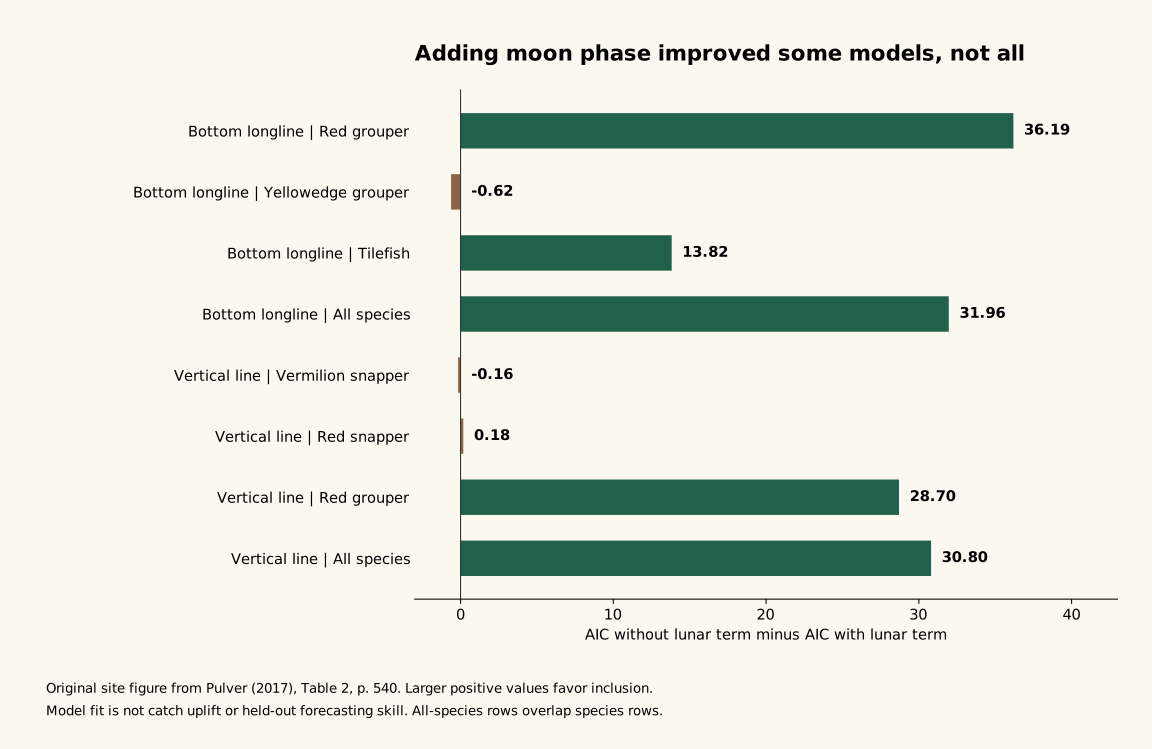
The revealing comparison was red grouper under two fishing methods: longlines carrying multiple hooks, and lines fished vertically below boats. The same fish did not show the same moon-phase pattern across those methods. Other fish/method combinations had no detected association. That is a reason to ask which fish and gear a calendar claim describes. ‘No detected association’ also isn't proof that phase has no effect in every setting; it states what that analysis detected for its records and design.
Water temperature and pressure were unavailable, and the records did not settle every tidal or daily timing question. The detailed results keep the table comparisons and calculations from the paper's models, with their other conditions held the same. Those conditional phase comparisons are not fresh observed catches or a held-out forecast for another fishery.
Read the model-fit comparison separately from catch-rate contrasts. An improvement in model fit after including lunar terms is not a percentage catch gain, and the full model's fit is not the share explained by the moon alone. The retained methods note distinguishes those outputs and the available source coverage.
What the other papers add
A New Zealand recreational snapper diary study found a strong seasonal pattern and smaller calendar relationships. Some unsuccessful trips and useful condition fields were missing. It is context from another fishery, not a Louisiana redfish experiment.
A later analysis reported an association while questioning the practical value of small effects. The original review had only its university abstract, not the complete paper, and did not extract detailed effect estimates. Those related records aren't treated as independent confirmations. Keep full-paper findings, abstract-only statements and this site's arithmetic distinguishable. Related analyses may share records, so a longer reading list doesn't automatically mean more independent replications.
This is a focused review of published work, not new Louisiana catch records, a complete review of every lunar study or a validated forecast.
Phase, tide and a bite clock are different
Moonlight depends on more than phase, including whether the moon is above the horizon and what blocks the light. Tide is changing water height; current is water moving in a direction.
A calendar's “major” or “minor” feeding period predicts a time within the day. A monthly phase association doesn't validate that particular clock-time window. Use the tide introduction for the local water questions.
Make the comparison useful to you
Choose dates you can use, a place you can access and an activity your group can manage. Read the actual forecast and water information. The review supplies no measured redfish advantage that should override those practical details.
If keeping a fishing log, include visits with no catch, the time actually spent fishing, people, method, fish you hoped to catch, place and conditions. Keep fishing time separate from the journey or breaks. Count released fish separately from kept fish. Exact local times and the calendar's actual prediction would be needed to examine a daily feeding-window claim.
The blank field log is optional and remains empty. Split entries when the method or number of active anglers changes, and retain the actual fishing interval, time zone, target, area and effort fields. Leave unknown conditions unknown; an observed no-catch attempt is different from a missing record.
The total-caught field includes releases. Record kept fish separately as part of that catch, not extra fish to add to it again. Keep travel, breaks and interruptions distinct from active fishing. A daily feeding-window claim would also need the calendar's actual predicted window recorded before comparing it with the attempt.
Use the template privately; it does not ask you to submit personal records. A few self-selected outings don't create a dependable lunar score or a causal test; independent fisheries/statistical review of the evidence case remains pending. Start with the fishing calendar and redfish guide when planning the activity.