Fish brought up from deep water experience a pressure change. Gas inside the fish can expand and interfere with its ability to return below the surface. This is called barotrauma.
A descending device returns a fish to deeper water before release. Venting uses a suitable tool and trained technique to release expanded gas. This page compares the evidence for those methods; it isn't a procedure for performing them.
The reviewed evidence supports preparing suitable release equipment and paying attention to how it is used. One Gulf comparison favored certain deeper descents, while another found similar survival with venting and descending. The result depends on the fish, depth, method and outcome measured.
Start each case with the same questions: which fish were included, what happened at release, how later outcomes were observed and which fish remain unknown. Compare the outcome labels before comparing the percentages.
What counts as a release outcome?
A tag return requires a fish to survive, be caught again and have its tag reported. A higher return rate isn't the same number as a survival percentage.
Acoustic telemetry uses sound-emitting tags and receivers to follow animals. Movement and depth help researchers work out what happened later: survival, death or an unknown outcome. A tag that is not detected does not automatically prove either survival or death.
Video can show a fish swimming away. That tells you about the immediate behavior, rather than whether it survived days later. Keep these outcomes separate before comparing percentages. A return-rate comparison includes later recapture and reporting, while a known-fate telemetry percentage includes only fish whose fate was classified. Neither becomes all-fish survival by dropping the steps or unknowns from its label.
Case one: different descent depths in the Florida Gulf
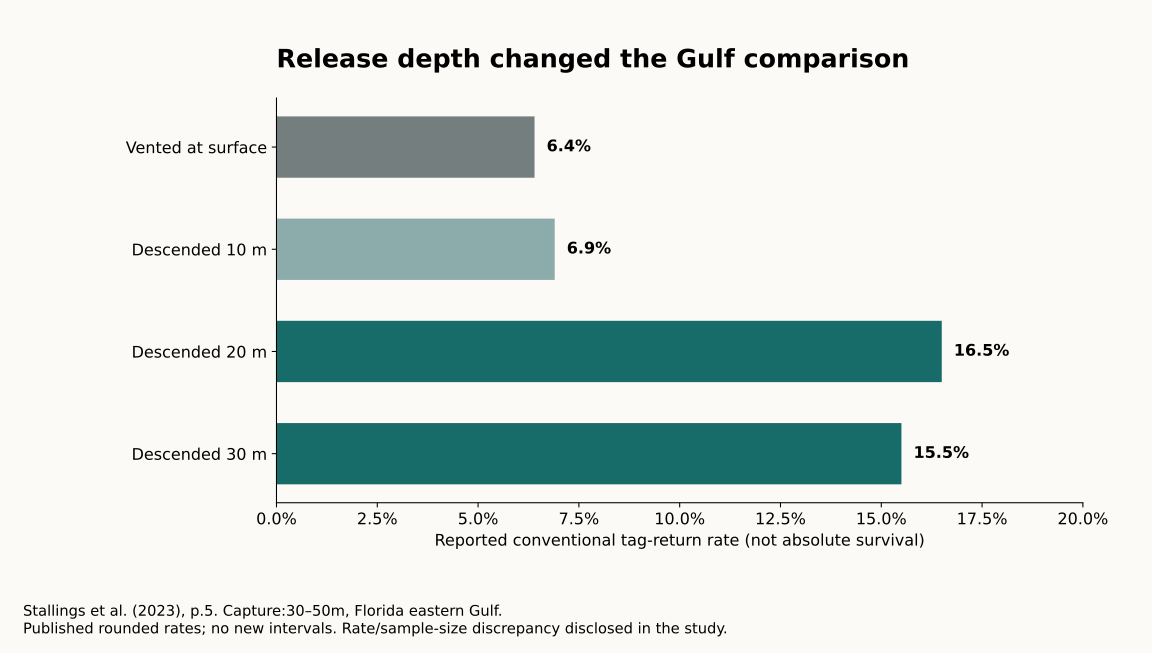
A study captured red snapper at 30–50 metres, roughly 98–164 feet. The comparison used lip-hooked fish without hooking injury and addressed visible barotrauma under the study's warm-water conditions.
Reported tag returns were 6.4% after surface venting, 6.9% after a 10-metre descent, 16.5% after 20 metres and 15.5% after 30 metres. The deeper two descents had stronger relative-return evidence; the short descent didn't show the same benefit.
These are study depths, not settings to copy onto every device. Assignment was not perfectly balanced, and the authors limited extension beyond their maximum capture depth.
The published percentages and group sizes do not fully fit together as whole numbers of returned fish. The original comparison preserves that discrepancy and does not invent return counts or a new count-based statistical test. Read the detailed result notes with the rates. A difference or ratio calculated from the printed rates remains descriptive arithmetic, not reconstructed fish counts or a newly reproduced source test. Preserve the discrepancy rather than choose a convenient count that makes the table appear complete.
Case two: delayed outcomes in Texas
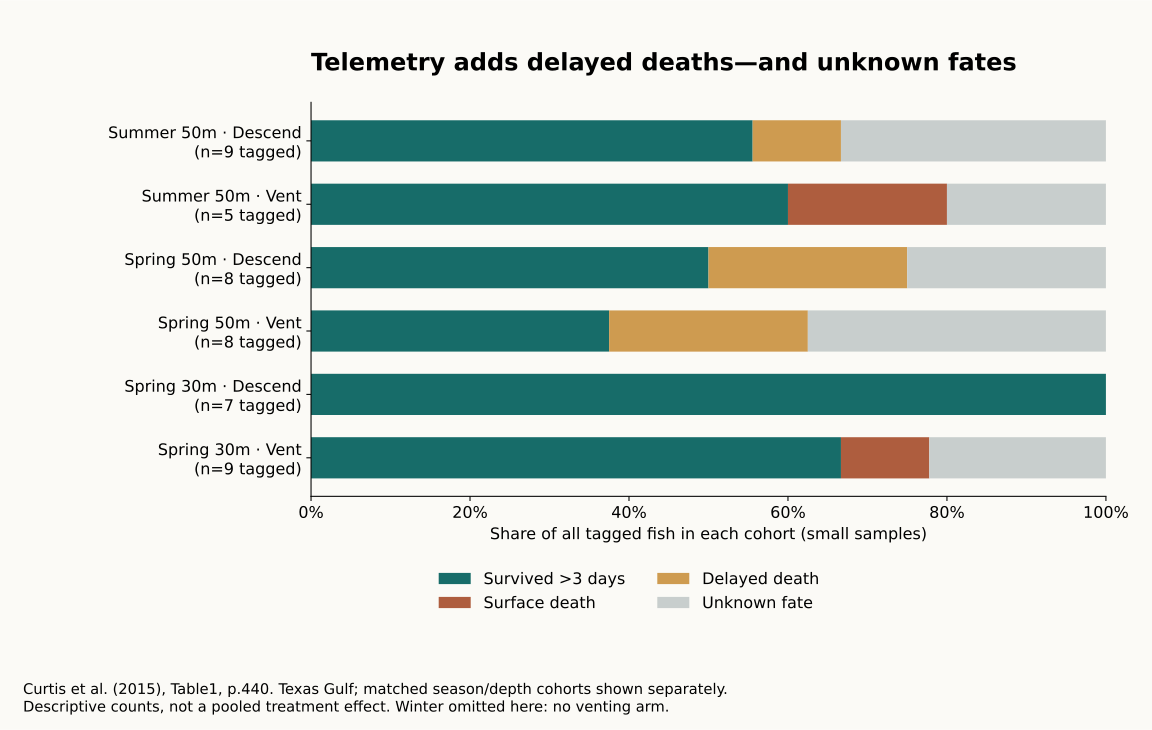
The Texas study used sensors to follow fish after release. All detected delayed deaths occurred within three days, including fish that had initially left the surface.
The authors interpreted vented and descended fish as having similar survival overall, with untreated surface releases performing worse, especially in the summer trial. Small groups and fish whose later outcomes are unknown limit the comparison.
The tables retain all tagged fish, the classifiable subset and bounds for unknown outcomes. Denominator means the total used to calculate a percentage. Using only the fish with known outcomes gives a different result from using every tagged fish; the unknown outcomes need to stay visible.
The retained telemetry rows keep season, depth, method, tagged fish, unknowns, classified outcomes and the alternative denominators together. The all-tagged bounds ask what happens if every unknown fish died or survived. Those are extreme missing-outcome scenarios, not confidence intervals or evidence that the unknown fish resemble the observed group. An absent treatment row is not a zero-survival result.
Case three: an estimate with a narrower scope
A North Carolina experiment followed descending at one site and had no venting treatment. Its best-case estimate excluded deep-hooked fish and unsuccessful first descents. A separate simulation, a computer-calculated scenario, assumed every fish was descended and no device failed.
That illustrates what can be achieved under specified conditions, not a measured Louisiana success rate. The three papers differ enough that this review does not combine them into one survival percentage. Keep the measured follow-up subset, best-case estimate and assumed simulation separate. The simulated no-failure scenario does not measure how often devices succeed or how a different crew's release will turn out.
Prepare the process before fishing
Have a qualified crew explain the equipment, roles and method before the first drop. Follow the equipment instructions and appropriate training; don't improvise venting or choose a release depth from one number in this study.
Hook injury, handling and predators remain part of the outcome. A descender doesn't repair every injury or guarantee escape from predators. These cases also don't isolate a general effect of descending on shark attraction.
Use the catch-and-release guide, red-snapper introduction and the linked responsible release guidance for preparation. Check current fishery requirements separately. The saved regulatory action record documents its date and scope. Use the responsible agency's current guidance for equipment requirements on your own trip. A dated action record and a historical study method are not substitutes for confirming current applicability. Keep that requirement check separate from training and the crew's actual equipment/role plan.
The review uses three primary papers and attributed aggregate results, not new fishing trials or raw tag records. Independent fisheries/statistical review is still pending, including the Florida source discrepancy. When reading the detailed charts and downloads below, retain the source, setting, inclusion rules, outcome and follow-up beside each result. Preparation is supported by the evidence without turning any one depth, rate or simulated scenario into a universal operating instruction.