An artificial reef is a place built underwater for animals to use as habitat—a place to live, shelter or feed. Fish can gather around it, and anglers may find fish there. The harder question is whether the reef adds fish growth or survival to the wider population.
The Gulf studies found useful habitat and local fishing opportunities. They did not measure how many extra fish the reefs added across the wider Gulf. A reef can attract fish and help some grow at the same time. Read each case by its actual measurement: local catch rate and fish characteristics, or allocated commercial landings. Neither becomes a net regional production measurement simply because fish were found at a reef.
Three ideas to keep separate
Attraction means fish move toward or stay near a feature. Production concerns fish growing and young fish joining the population over time. Biomass is the combined weight of fish present at a particular time. A reef can have more fish gathered around it without that whole increase being new growth.
To claim an added population benefit, ask what would have happened without the reef. Fish growing there might otherwise have grown elsewhere. Movement, survival, fishing removals and the surrounding habitat all matter.
Catch rate compares catches with the amount of fishing, called effort. The unit matters: fish caught each time gear is set and fish caught per hour are different measures. Landings are catches brought ashore. Neither tells you the total number of fish living in the Gulf.
Case one: a new Texas reef
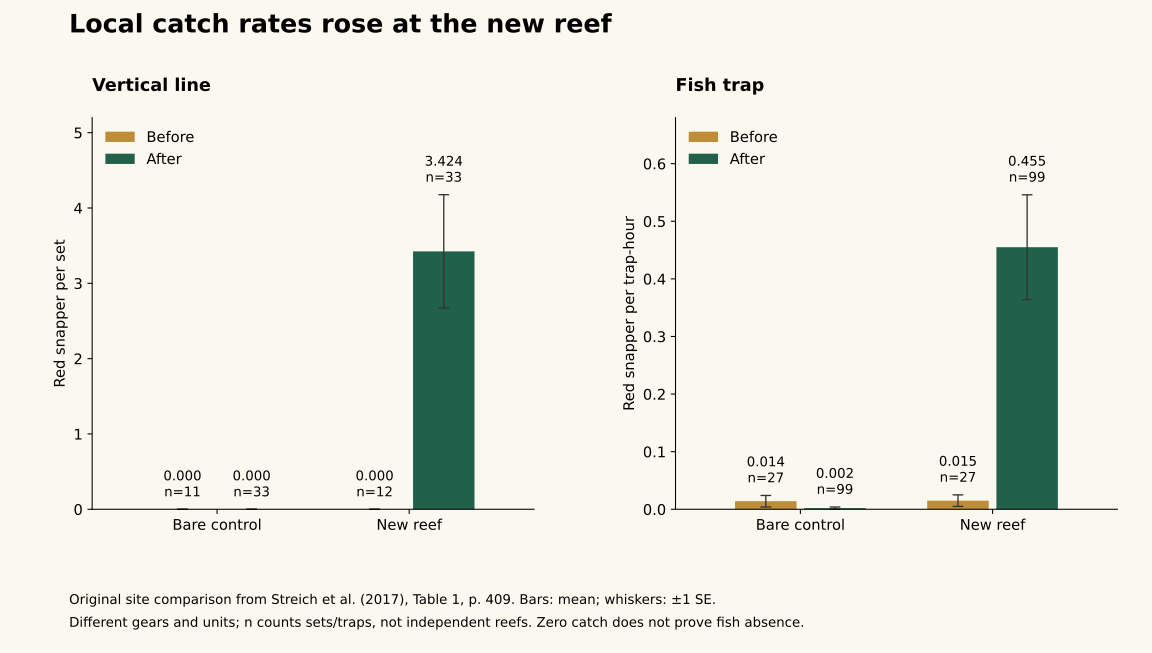
A study near Port Aransas sampled a new reef and a nearby bare-bottom control, a comparison area without the new reef, before and after construction. The reef's local red-snapper catch-rate increase was much larger than the control's.
The researchers also examined fish age, size and condition. Their evidence was consistent with young fish using and growing in the new habitat, so the result involved more than a photograph of fish appearing there.
But the researchers returned to one reef complex and one control; they did not repeat the comparison at many separate new reefs. Survival wasn't directly estimated, and a change in the ages sampled can also reflect fish moving in or out. The case supports habitat value for young fish without measuring how much extra fish growth or survival the reef added across the region.
The retained catch-rate groups keep gear, effort unit, site, period, mean, reported error and sample count together. Sets and trap-hours are different denominators. The sample count describes fishing samples, not that many independently constructed reefs. Read the before/after change with its control and sampling design rather than treat repeated visits as separate reef experiments.
Case two: where commercial catches were taken
A second study combined vessel movement, reported landings and habitat maps across selected Gulf years. It estimated fishing removals around different habitat types, rather than new fish production.
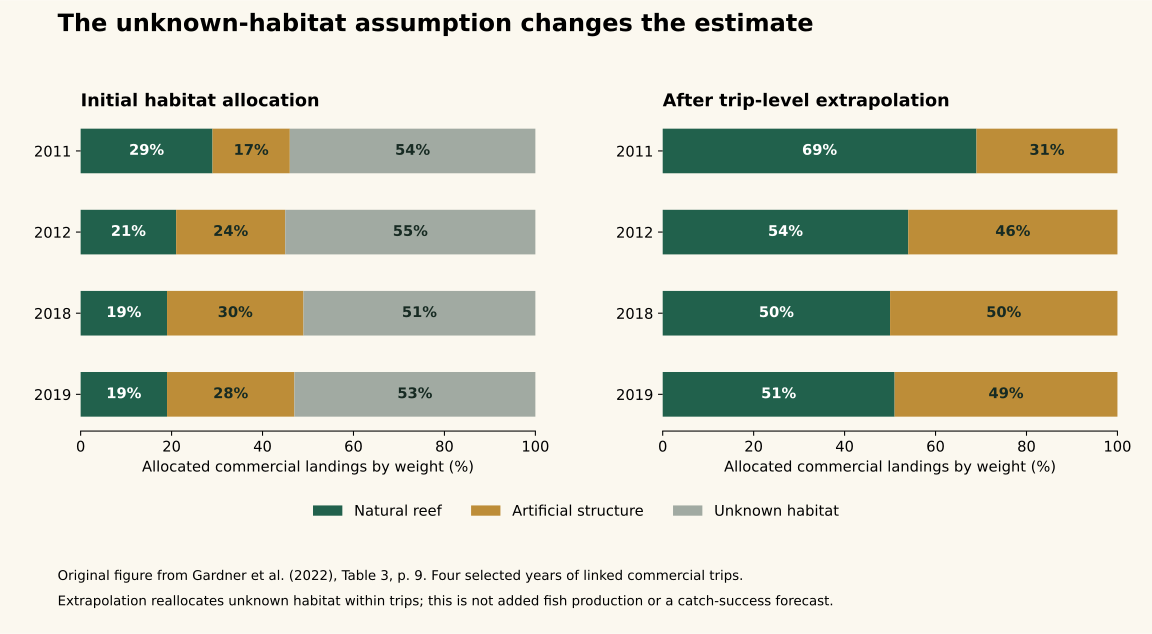
The records initially left much of the catch unassigned to a habitat. Extrapolation means extending a known pattern to the unknown part. Here, the study used assumptions about the habitat mix identified on each trip to assign its remaining catch. Those assignments depend on the assumptions; they are not direct observations of every catch location. Keep initially assigned, unknown and extrapolated shares under their own labels. An allocation to a habitat is not an added amount of fish produced there.
The Louisiana estimate showed artificial structures were important to that sampled commercial fishery. A share such as 73% is not a 73% chance that your trip catches snapper, the share of all snapper living there or the share produced by reefs.
The detailed charts keep the unknown share and the extrapolated allocation visible. Commercial vertical-line fishing, where gear is worked below boats, is also a different activity from every recreational outing. The retained commercial-landings comparison preserves the published allocation categories; it does not map individual catches for a future trip. Keep the stated years and fishery with those shares instead of generalizing them to today's entire Gulf population.
How the evidence was assembled
This page compares two Gulf studies with numerical results. A later research paper provides background for interpreting the findings. The original review inspected the main papers and principal tables. This site's figures compare the published group summaries, crediting their sources. They do not use a separate record for every fish or private vessel tracks.
The perspective's separately licensed table and figures were not adapted. The two cases aren't pooled into a new Gulf production estimate. The detailed results keep the reported averages, sample groups, habitat-assignment assumptions and source limits. Descriptive changes calculated from group summaries remain distinct from the original authors' fitted models. More local biomass, a higher catch rate and added regional production need different evidence, even when all sound like ‘more fish.’ Independent scientific review remains pending.
Use the habitat lesson on a trip
A reef label alone doesn't describe the day. Ask whether guests lower bait, work a weighted lure below the boat or cast along a shallower feature. Match the activity to the people, travel and effort. Confirm what the actual booking offers, who handles the equipment and how the crew manages a turn, landing and release. The historical habitat result does not supply those arrangements.
A wreck is a sunken vessel. A platform is a fixed or floating working structure. These and smaller coastal reefs differ in depth, shape and use. Use the Louisiana Department of Wildlife and Fisheries’ reef information for the actual site context; a coordinate isn't landing permission or a complete navigation plan.
Learn the offshore methods, identify the fish and prepare for releases before fishing. The study explains evidence about habitat; it doesn't forecast a catch or prove that further removals at a productive-looking spot are unlimited.