A circle hook curves its point inward; a J-hook has the more open shape suggested by its name. Those labels start a comparison, but the point's alignment and the whole fishing setup matter too.
In the relevant bait-fishing comparisons, non-offset circle hooks were less likely to hook redfish deep inside. That is useful, but it does not give one survival percentage for every fishing setup. Read each result with its hook configuration, fish group, fishing method, outcome and follow-up. A comparison about injury location and one about observed deaths answer different questions, even when they use the same fish.
Learn the important words
With a non-offset hook, the point does not stick out sideways from the straight part when viewed edge-on. An offset point is bent to one side. A circular bend alone doesn't tell you which you have.
Deep hooking means the hook is caught inside the fish rather than at its mouth. Mortality means deaths. Survival needs follow-up for a stated period; a fish swimming away isn't a long-term survival measurement.
A rig is the arrangement of line, weight, hook and other fishing-end parts. Natural bait is food placed on the hook. The hook-shape lesson explains these ideas before you choose a setup.
One study shows why the outcome matters
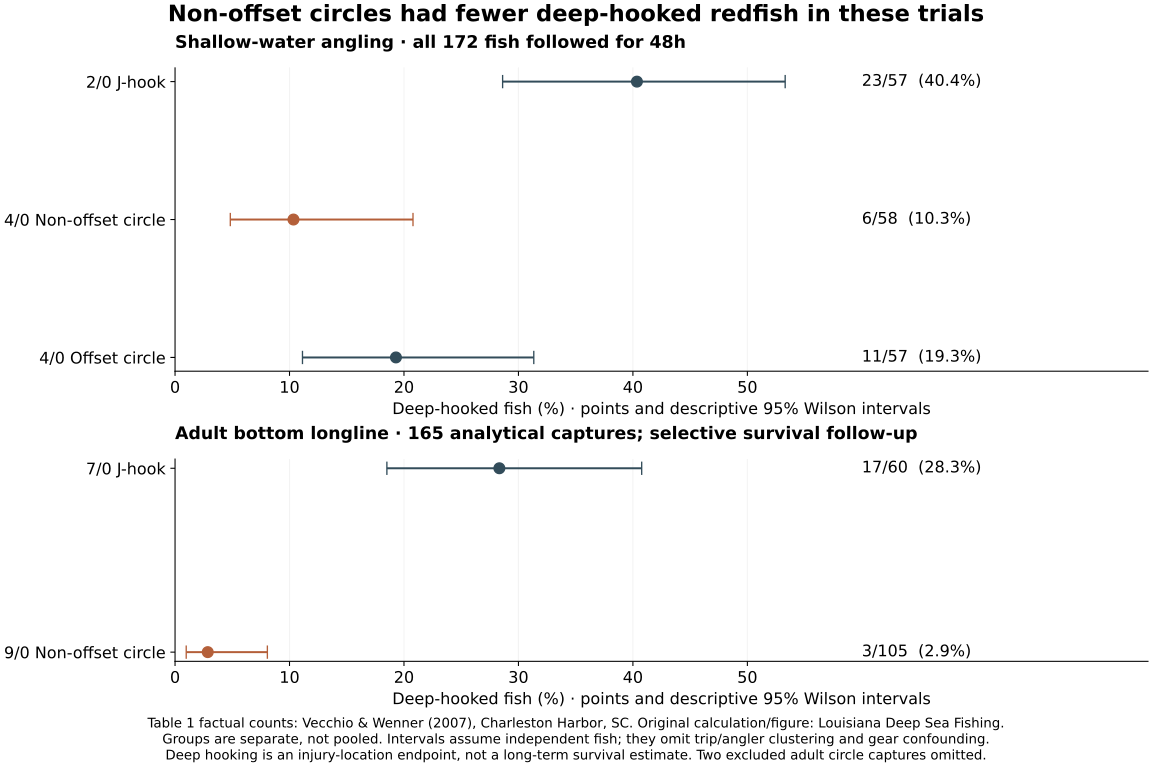
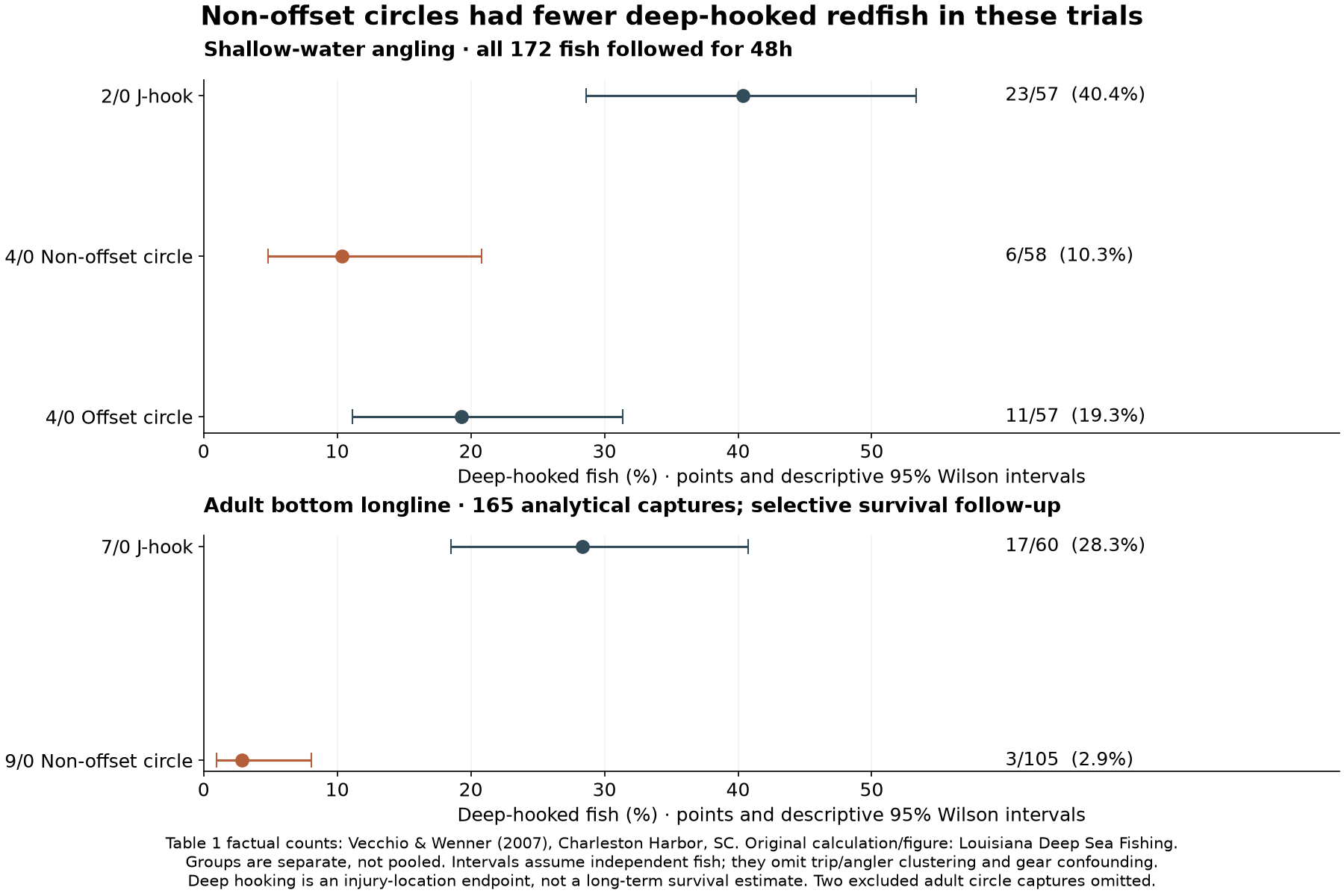
A 2007 Charleston Harbor comparison followed 172 smaller redfish for 48 hours. Deep hooking occurred in 23 of 57 J-hook captures, 6 of 58 non-offset circle captures and 11 of 57 offset circle captures.
Those are about 40.4%, 10.3% and 19.3%. The recorded deaths in the same groups were 4, 1 and 6. The authors did not find a statistically significant overall mortality difference: their analysis did not establish that the hook groups had different death rates beyond the variation expected in this study.
The non-offset group had less deep hooking, but the deep-hooking percentage isn't a survival percentage. The tested setups also used hooks with different size labels. The study did not isolate hook shape from every other equipment difference. Failure to detect an overall mortality difference also does not prove that the groups had identical survival. Keep that test result alongside the reported death counts rather than replace one with the other.
The other groups answer different questions
The same paper's adult comparison used bottom longlines—long lines carrying multiple hooks near the bottom. That was a different method from the smaller-fish comparison. It retained only deep-hooked adults for survival observation. Unobserved adults cannot be counted as confirmed survivors, and excluded fish remain recorded in the evidence. A result for the selectively followed deep-hooked fish cannot become whole-group survival by treating the remaining fish as alive.
A Tampa Bay study followed 251 fish for 48 hours, with 14 recorded deaths. It associated deep hooking with hook type, while mortality related to temperature and hook position rather than directly to hook type. Its separate survey and later tag analysis use different fish counts and aren't pooled into one survival estimate.
A Neuse River study examined hook and leader/weight arrangements in adult bottom fishing. Its outcome was deep hooking, not mortality. Differences in year and the surrounding rig mean it isn't a test of leader length alone or a recipe for a small shrimp under a float.
Read the counts before the headline
The detailed tables preserve the original hook configurations, fish groups, denominators and follow-up limits. A proportion is a count divided by the relevant total, also called the denominator. Use the fish in that comparison group, rather than every fish mentioned in the paper. The ranges around some proportions show how uncertain a small count can be; they are not a new experiment proving a universal hook difference.
The retained Charleston groups separate examined fish, deep-hooked fish, deaths and the number followed for mortality. Check which denominator belongs to the outcome before reading a percentage. A blank whole-group mortality value means it wasn't established for that group, not that no fish died. Don't add adult, smaller-fish and other-study rows into one survival total.
This site reviewed three primary papers and calculated comparisons from attributed published summaries. It did not conduct the fishing trials, acquire individual fish records or review all available hook research systematically. Different groups are kept separate, and missing follow-up stays missing. The descriptive ranges and arithmetic do not adjust away every difference in gear, bait, fishing group or follow-up. They help read the published summaries; they do not turn the comparison into a new controlled trial. Independent fisheries/statistical review remains pending.
Put the finding into a complete lesson
For bait fishing where releases are expected, discuss a suitable non-offset circle with the instructor and learn the response to a bite for that setup. Don't simply copy the motion used with another hook or bend the point and assume the same evidence still applies.
Arrange who brings a fish under control for unhooking—landing—and who handles release before fishing. Use the hooking and landing lesson, catch-and-release guide and current rules for the actual fish and water. Read the practical takeaway back as separate tasks: identify the actual hook, learn its bite response, arrange handling/release roles and check current requirements for the outing. A hook-change decision doesn't complete the other tasks. Reducing one injury risk is useful without promising that every released fish will survive.