
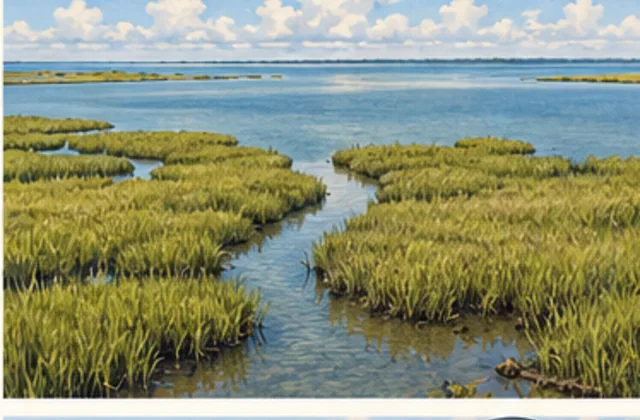
A marsh is wetland with grasses and connected areas of water. A drain is a narrow passage between those water areas—for example, where a pond connects to a bayou. A bayou is a slow-moving waterway or channel.
Anglers look at these connections because water can carry food through them. You don't need to recognize a famous fishing spot. Start by noticing the shape and watching what the water is doing. Keep the feature, observed movement and your fishing attempt separate: a recognizable opening doesn't establish flow direction, depth, access or a fish location.
Learn the shape before choosing a cast
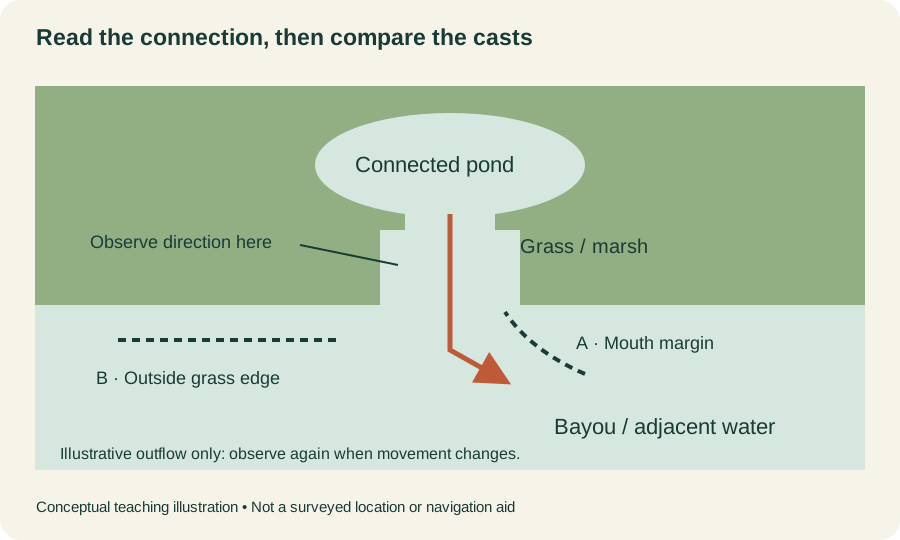
The mouth is the opening where the narrow passage meets the wider water. A point sticks out from the bank; a pocket is an indentation. A grass edge is where the vegetation meets open water.
A drain can carry water outward, inward or show little movement when you arrive. Its name doesn't mean it's always emptying the pond.
In this drawing, water is shown leaving a pond. One marked casting path follows the edge of the opening; the other follows the grass beside it. Those are places to compare, not marked locations where fish are known to be. Match the sketch's feature names to what is visible at your actual position, without assuming its outward-flow arrows describe the water when you arrive.
 Open the full-size illustration →
The drawing explains the feature. It isn't a surveyed location or a route for a boat. A visible opening doesn't tell you its depth or whether you can enter it.
Watch for a few moments
From a suitable fishing position, follow naturally floating leaves or foam. Don't throw anything into the water to check it.
Does material leave the mouth, enter it or circle nearby? Compare several pieces and the water beside the opening. Wind can move surface material differently, so one ripple isn't enough to explain the whole flow. Write ‘material moving outward at the surface’ when that is what you observed; keep the cause and movement below the surface open unless you have evidence for them. A tide-table label doesn't replace this local observation.
Notice small fish, shrimp or other visible activity without guessing which larger fish caused it. ‘Small fish scattered beside the grass’ records what you saw. ‘A redfish chased them’ adds an identification and cause you may not have been able to see.
Choose one manageable path
You might watch bait below a cork beside the mouth or bring a lure along the outer grass edge. Bait is natural food on a hook, a cork is a surface float and a lure is artificial. The cork lesson and paddletail lesson explain those two activities.
Begin with a short cast and a clear way to bring it back. Name the edge or mouth you are comparing, the intended path and what the cork or lure should do under the method's instructions. Watch whether the water carries it along that path or your line pulls it somewhere else. Bringing it back is called the retrieve. Keep an unseen lure's exact position unresolved.
If the hook or lure keeps returning with plants, bring it back, clear it and compare where it traveled with the visible edge. Try placing it farther into clear water. If it still reaches plants below the surface, review the hook's reach or lure's depth using the method you're learning.
Compare one change
Here's an imagined example. Leaves are leaving the drain, but a long cast leaves your line curving across the flow and pulling the cork away from the edge. You wind it back, then try a shorter cast beside the same edge with the same hook-and-float setup, or rig.
If the shorter cast follows a path you can control, note that difference. If it still gets pulled away, record that too and try a clearer patch or another change on a later cast. You don't need a bite to see whether the line followed the intended path. Inspect the returned bait or lure, joins and any plant material before repeating. Hold the same rig and method while comparing casting distance; if you also change leader, weight and retrieve, you cannot attribute the result to the shorter cast alone.
If the flow changes, watch again before repeating the same cast. A useful note separates the observation and the attempt: ‘Leaves moving out of the mouth; shorter cast stayed beside the outer grass edge.’ That gives you something to compare on the next visit without treating one casting position as a permanent answer. Record a changed wind or surface movement as a new condition, not simply as a failed repeat of the first attempt. If the chosen path cannot be managed from the position you can use, choose a reachable alternative rather than enter the opening to copy the drawing.
Marsh fact sheet
Use the blank observation sheet if you'd like a record of your visit. It's a CSV file you can open in a spreadsheet. Or keep the same simple notes on paper or your phone.
The sheet separates date/local time and time zone, water type, the feature without private coordinates, observed movement and visible forage, presentation/equipment, effort and its unit, one change, result and uncertainty. Forage means small animals that other fish may eat; record what you actually saw rather than infer the predator. Choose an effort unit you can state consistently instead of leaving an unlabeled number.
For the shorter-cast example, the result can be ‘cork stayed beside the outer edge; hook returned clear.’ The uncertainty can remain ‘bait position and larger fish identity not observed.’ A blank sheet supplies fields, not measurements, proof of access or a catch report.