
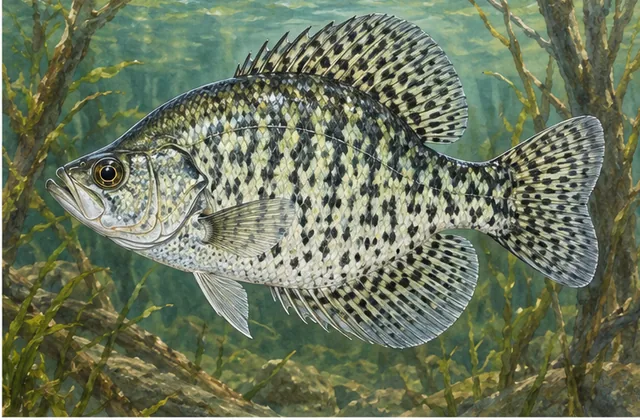
Crappie are freshwater fish you'll hear about around Louisiana lakes, bayous and reservoirs. Sac-a-lait is a familiar Louisiana name for them. Some people also use “white perch,” which can mean a different fish elsewhere.
A crappie outing might involve watching a float, lowering a small jig or learning where a bait sits in the water. You don't need to master all three to begin.
White and black crappie are different species
Both names occur in Louisiana fishing. Crappie are tall from back to belly and thin from side to side, with darker markings on lighter sides. The arrangement of those markings and other features help with identification.
Don't identify one simply because it looks darker or lighter in a photograph. White crappie and black crappie are species names, not just descriptions of color.
Read a full identification reference before the outing and ask for experienced help with an uncertain catch. Record only features actually visible and leave uncertain identity open. Sac-a-lait means crappie here, but keeping decisions and rule searches need the confirmed full species name rather than a regional nickname.
Understand why people talk about cover and depth
Cover means objects or plants in the water, such as branches, brush or vegetation. Schooling means fish grouping together.
Keep bottom depth, intended bait level and evidence of fish position as three questions. Branches, fish and bait can occupy different levels. The lake's total depth doesn't tell you how far down to fish, and visible brush isn't proof fish are waiting beneath it.
Ask: “Where are you trying to put the bait, and how will I know it's there?” That makes a depth discussion more useful than memorizing a number from yesterday's report.
Try a float or jig activity
A float, also called a cork or bobber, sits on the surface with the hook or jig below it. It gives you something visible to watch as the bait settles and moves.
A jig combines a weighted head and hook, sometimes with a soft body, hair or other material attached to attract fish. It can hang below a float, be cast and brought back, or be lowered beside a boat. Those are different presentations of the gear; a float and jig can be used together. Have the actual movement, pause, line controls and return demonstrated instead of applying the same motion to every arrangement.
A small minnow, often called a shiner, is one natural-bait option. A small jig is an artificial alternative. You don't need to use both at once to start learning.
With a known float setup and appropriate help, choose a suitable permitted position with casting space and a clear return. Make a short cast beside the cover, let the float settle and follow where it moves. The float is a surface reference, not the exact hook position; spacing and line angle affect the arrangement, and spacing alone doesn't measure bottom depth.
A dip or changed movement is a reason to pay attention, though flow or a caught hook can also move it. Have the response demonstrated for the actual hook before casting. Retrieve means bringing the line back; do so before it reaches an obstruction or becomes unmanageable, as well as at the checks you've been shown.
Bring the setup back and inspect the bait, hook and line. If the bait repeatedly returns covered in plants, have someone show you how to shorten the distance between float and hook so it hangs less far down, or try a clearer cast path. Compare one change at a time; look at what comes back on the next cast. The freshwater-rigs lesson explains how the parts fit together.
For an illustrative comparison, keep the rig the same while trying one clearer path. Record float landing point, later path and returned bait or line condition, with catch or no catch separately. If changing float spacing instead, keep the path and other setup details the same and have the adjustment shown. Returned plants do not identify fish or measure their depth.
Keep casts manageable and ask for help with hooks and tangles; boat positioning and moves remain with the operator. A specific rod length or lure weight from another outing isn't a required beginner shopping list.
Choose a place and the kind of help you want
Lake D'Arbonne, Toledo Bend and Caddo Lake offer different settings to investigate. Choose the bank, launch or guide meeting point you'll use; a lake name alone won't tell you where to go.
For a guide, establish the actual method, demonstrations, supervised attempts, turns, fishing and rest positions and handling help. Keep these with the boat, departure, hours and complete group price, separating supplied gear from included instruction and other services. Explain the learning goal clearly; a fishing day is not automatically a lesson. A changed water, boat or method needs those affected answers reviewed.
You can inquire with the Toledo Bend guide service or Living the Dream about their services. Tell them which lake you're considering and that you'd like the method explained.
Plan the catch decision before you start
Use the Louisiana Department of Wildlife and Fisheries' freshwater information for the actual species and water. Check identification, measurement and count conditions before keeping fish.
Check personal requirements separately and decide release or lawful keeping before starting. Agree who brings the fish within reach, identifies and measures it, handles the hook and manages release or storage. The hooking-and-landing lesson explains those jobs so help is arranged before it's needed.
For kept fish, resolve preparation, charges, collection place and time, who collects them and cold transport. Allow for the handoff, equipment and rubbish cleanup and return journey rather than scheduling onward travel from the last cast or dock return alone.