
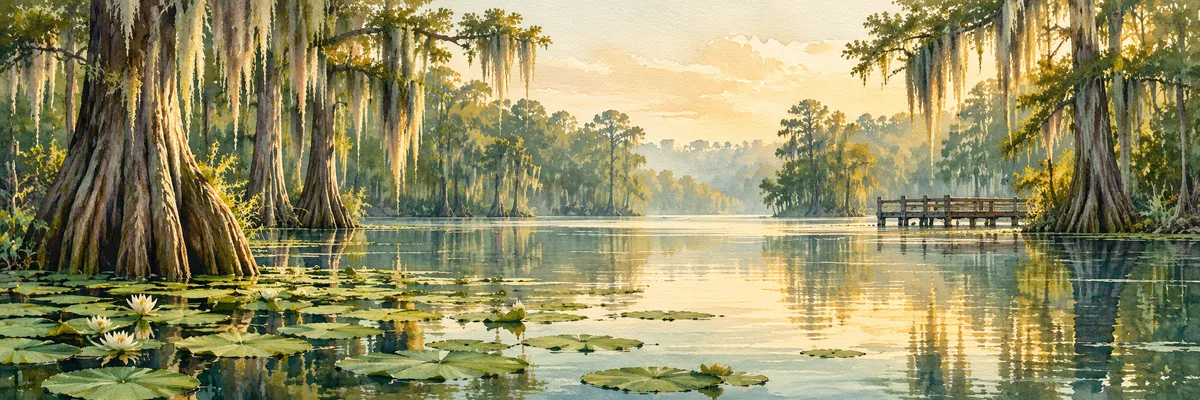
Caddo Lake spans the Louisiana–Texas border. Its cypress trees, plants, bayous and broader open areas can make one part look quite different from another.
Choose the particular side, managed site and activity before directions, a room or equipment. Cypress scenery is not a permitted bank position, current launch arrangement or route between trees. Keep those access questions separate from what the habitat might suggest about fishing.
Get to know the features
A bayou is a waterway or channel. A slough is a backwater or shallow water connection. Those features can link different parts of the lake, but the name alone doesn't establish depth or access.
Trees and vegetation are cover. Channels, slopes and other bottom shapes are structure. Fish may use those features, but not every tree has the same water around it or a fish waiting beside it.
A lure is artificial; natural bait is food on a hook. With a suitable known setup and help where needed, choose a reachable feature and a manageable cast-and-return path from the permitted position. Learn line release/stopping, the intended movement or wait, the actual hook response and retrieval—bringing line back with the reel. Arrange landing and hook help before a fish is caught.
For an illustrative observation, ‘the line carried the float toward vegetation and the returned hook held plants’ describes a path/result, not a fish location or depth. Compare one clearer or shorter path with the same setup before changing equipment and movement together. The cover-and-structure lesson helps keep visible objects distinct from bottom information you do not yet have.
Choose a named place to begin
On the Louisiana side, Earl G. Williamson Park is a managed site to investigate. The U.S. Army Corps of Engineers Caddo information provides another official research starting point.
Texas's Caddo Lake State Park is a different site and manager. Don't treat facilities shown for one place as amenities at another.
For the chosen site, retain state/manager · exact entrance/facility · permitted activity · hours/charges · source/date · unresolved question. The Louisiana park, Corps information and Texas park are separate research records; do not move one site’s amenities, permission or instructions to another.
For shore, trace parking to the actual fishing position, facilities/breaks and return while carrying gear. For a craft, establish the actual launch, parking/recovery and separate route/operating preparation. A facility name or opening listing does not by itself answer every part of the visit. The access guide helps ask about the precise route and position.
Decide how you'll fish
A bank or pier outing can keep the equipment and time manageable when a suitable public site is available. A pier is a structure extending over the water; a ramp isn't automatically a shore-fishing platform.
A boat or kayak needs appropriate equipment, operating skills, local information and a definite return plan. Visible water between trees isn't proof of a usable route. This page doesn't teach navigation through Caddo's channels or marked boat lanes.
For guided help, first establish a current service for the actual Caddo water/date/group. Ask for the departure, assigned boat, method, demonstration/practice turns, guest positions and full quote/inclusions. A regional business reference or a guided offer on another lake is not a Caddo booking. Keep an unestablished service open rather than infer availability.
Compare the activity and work remaining with the group, not only the scenery or fish list. A shore session, own-craft outing and instructed boat day need different equipment/help and return jobs; the guided-versus-independent guide follows those decisions.
Check the border-water conditions
Use the Louisiana Department of Wildlife and Fisheries' licensing information and the applicable Texas/border sources for the actual person, site and activity.
Reciprocity means recognition under an agreement, not blanket permission for every guest, shoreline or nearby water. Retain the actual person/license/date, where fishing occurs, any travel between waters and where catch is brought ashore. Departure or accommodation on one side does not describe the whole activity.
Keep the responsible source, applicable period, conditions and unresolved question with that plan. Resolve fish identification, keeping and transport separately from personal licensing. If side, water, activity or date changes, revisit the affected questions instead of carrying over the room address or another lake’s answer. The border-water lesson explains the separation without announcing current privileges here.
Finish with the gear and return
Assign personal/shared supplies, breaks/facilities, meeting/finish, return transport and change contact before leaving. Agree release or lawful keeping and the handling/identification help needed. If keeping fish, establish cleaning/collection/packaging, charges and cold transport separately from a boat’s storage or a park listing. Keep clipped line, hooks and damaged lure material contained.
Inspect wet equipment for plants and other hitchhikers before moving it elsewhere. Follow the clean, drain and dry instructions for your equipment and location. That applies to nets and footwear as well as a boat and trailer.
Keep the exact facility, position/date, known setup, observed path/result and one next question. Review current site information again before a return; prior use does not establish today’s permission or conditions. The freshwater checklist helps retain the full visit’s jobs, with unanswered essentials still visible.