
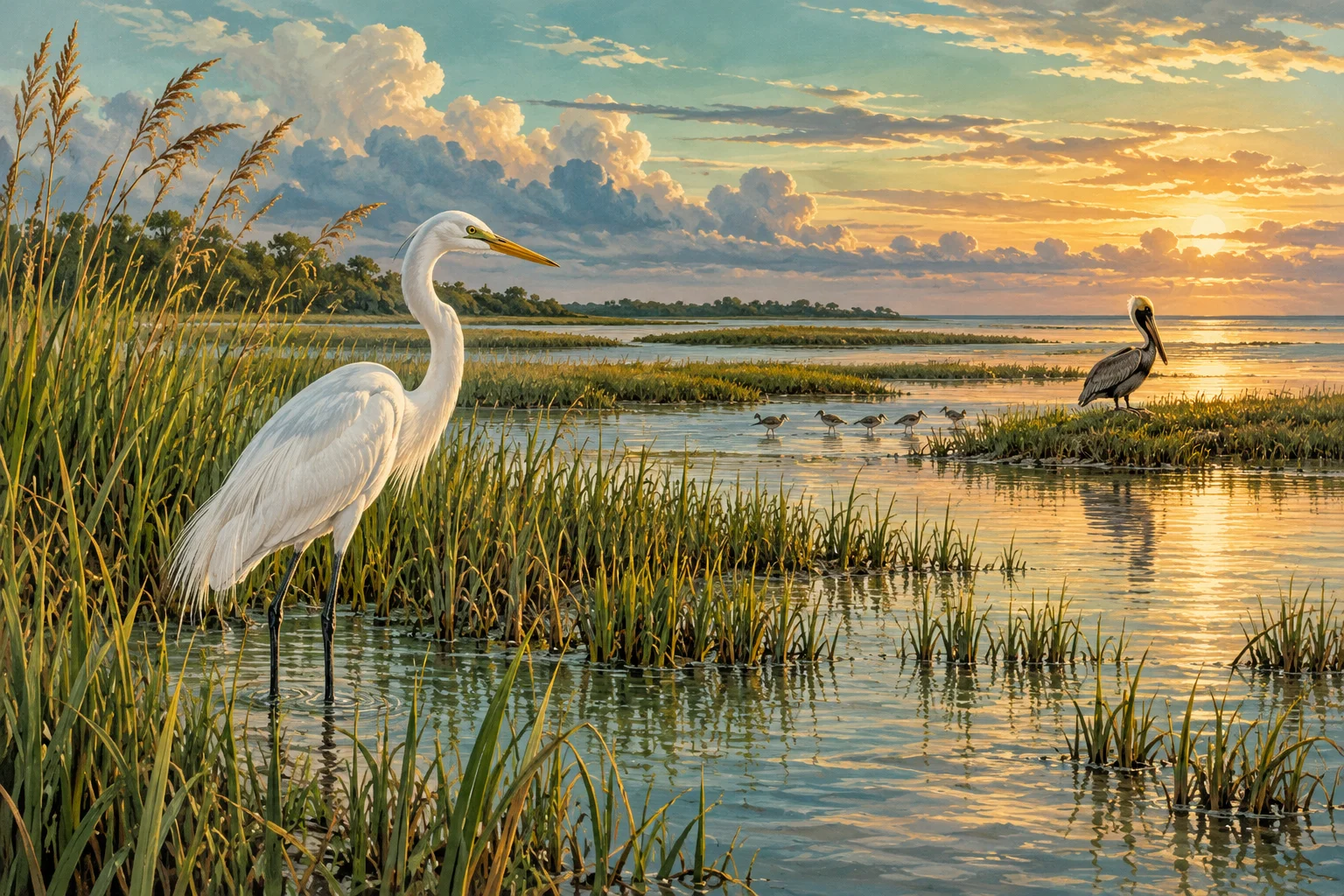
Birdwatching starts with noticing birds and what they do. You don't need to know their names or own a large camera before you begin.
Louisiana's beaches, marshes, wooded wetlands and open water give you different things to watch. A short visit to one accessible observation point can be enough for a first outing.
Begin with the place
A marsh is a wetland where plants such as grasses and reeds grow, rather than a wooded swamp full of trees. A beach offers open sand and shoreline; a wooded wetland has trees. Those settings give birds different places to feed, rest and shelter.
Choose a public path, viewing area or other permitted position with room to stop. Check the exact entrance, parking, walking surface, distance to the observation point, hours and facilities your group needs. Include carrying equipment and a place for breaks; a route described as a birding area doesn't answer whether the approach works for everyone.
Choose one position and a manageable visit before assembling a long list of possible species. Allow time to pause, walk back and clear the site before the applicable closing arrangements.
Big Branch Marsh National Wildlife Refuge, near Lake Pontchartrain's north shore, is one official starting point to investigate. Use the refuge's own information to choose a visit rather than assuming every route is open.
Follow one bird before naming it
Stay in one viewing position and pick a bird you can see comfortably. Here, 'follow' means watching its activity, not walking after it. Notice how it moves:
- Wading: walking through shallow water.
- Diving: going into or below the water.
- Skimming: moving just above the surface.
- Searching the shoreline: walking or probing along an edge.
Then look at body shape, the bill—its beak—legs and markings. Record size only if you can judge it; parts hidden by vegetation or a brief view stay unknown. ‘Long legs, pointed beak, standing in shallow water’ gives you more to compare with a field guide than ‘white bird.’ Use several matching features rather than a name chosen from color alone.
Compare the note with the reference afterward. If a feature doesn't match or wasn't visible, keep the identification provisional; don’t change the observation to fit the expected species. If the bird disappears and another appears, mark that uncertainty rather than join their features into one animal.
Binoculars help bring the view closer without moving your feet. If you don't have them, begin with a bird visible from the path and learn its behavior first. A useful record includes place, date and time, habitat, visible features, action and the identification or unresolved question. No species name is required to make that record worthwhile.
Let the birds keep doing what you came to see
Stay back from feeding and resting groups. If birds keep moving away as you advance, stop and increase the distance instead of following them again.
Nesting areas need particular care. A colony is a group of birds nesting close together; a quiet-looking island or beach may contain nests you can't see from a distance.
Follow posted boundaries, keep pets away and leave eggs and chicks alone. Breton refuge visitor guidance is a starting point for learning about a Louisiana barrier-island setting, not a general invitation to land anywhere.
For a boat or island visit, establish the actual viewing area, whether landing is permitted, the crossing, group facilities and complete return before booking transport. A route or site change needs its own access and viewing answers; it doesn't inherit another location's arrangements.
Add birds to a fishing day
Look around before casting. Keep hooks away from birds, contain bait and fish scraps, and collect trimmed or discarded line. Feeding birds beside the boat makes the fishing area harder to manage.
For an injured bird or one caught in gear, tell the crew if aboard and use the Louisiana Department of Wildlife and Fisheries' wildlife reporting guidance. Give the actual location, observation time, visible problem and whether it remains visible or where it was last seen. State uncertain species or injury details as uncertain. Don't pull at line or hooks yourself or move closer for a missing identification feature; follow the responder's instructions. The cleanup guide helps prevent loose fishing waste being left behind.
For a first outing, choose one observation area, bring drinking water and suitable clothing, and assign any shared equipment and rubbish cleanup. Keep the return walk or unloading and onward travel in the schedule, not just time spent watching.
For an illustrative learning note, ‘one bird watched from the path; long legs visible; bill partly hidden; walking through shallow water; species uncertain’ is a complete start. Keep the place and time beside it. No bird seen during a short visit doesn't prove the habitat is empty, and a photograph from another day doesn't promise the same view. The next useful step can be comparing the note with a reference, not walking closer.