
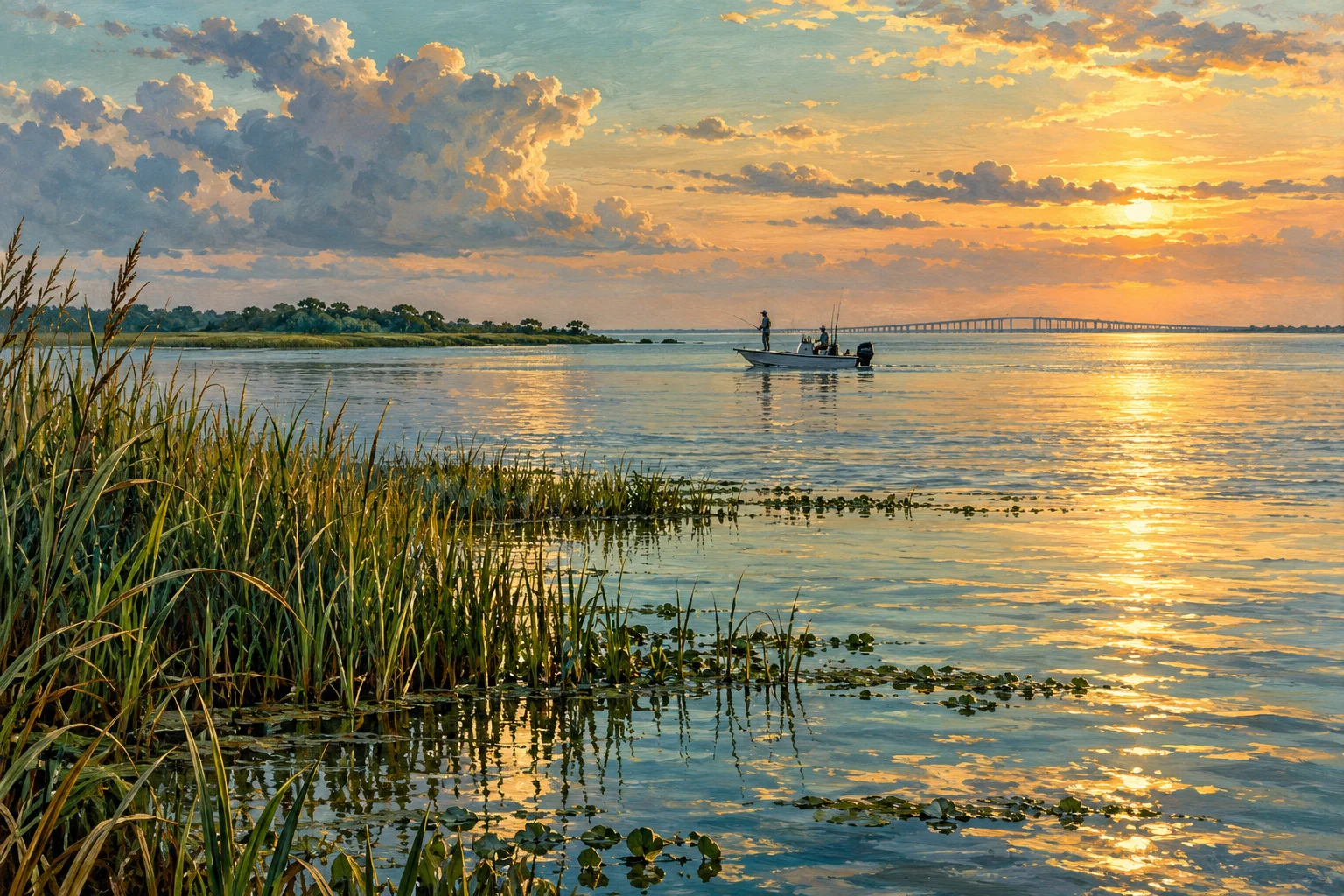
Lake Pontchartrain is a large coastal lake near New Orleans, connected with both freshwater inputs and saltier coastal water. It's part of an estuary, a system where fresh water and seawater mix.
That helps explain why you shouldn't plan it like a small, sheltered freshwater pond. Choose a specific shore site or boat outing and learn what that place involves. “Fishing on Lake Pontchartrain” names a broad setting, not a confirmed access point, sheltered route or particular lesson.
Get to know the water before the fish list
Brackish means a mixture of fresh and salt water. Salinity means the salt concentration, which can differ with location and conditions.
The U.S. Geological Survey's Lessons on the Lake explains the estuary. It's educational background, not a current measurement for your fishing spot. A fish report from elsewhere on the lake also doesn't establish today's salinity, depth or fish position beside you.
Wind can affect a broad expanse of water even when the view from shore looks inviting. Match the weather product's area and valid hours to the actual shore position or planned boat route, including the return. A city forecast or a favorable observation at one moment does not describe that whole outing. The marine-forecast guide explains the source and timing questions.
Choose shore, paddle or boat
A bank is the land beside the water. A pier extends over it. Either could suit a shore outing when the particular site permits fishing and has an approach that works for you.
A kayak or powered boat adds a launch, operating skills, equipment and a return plan. A ramp answers a boat-launch question; it doesn't automatically provide a comfortable or permitted place to stand and fish. Learn craft handling before adding fishing jobs; choosing a nearby launch doesn't establish a suitable route beyond it.
Find the facility name and the organization that manages it. Check its notices, allowed activity, hours, charges and route from parking before packing. Include carrying equipment, room to use a rod and somewhere for breaks. Big Branch Marsh National Wildlife Refuge is an official north-shore visitor-information source. Read the rules and notices for the exact activity and facility instead of assuming every refuge edge is open for it.
For a guided boat day, get the actual boarding point, assigned boat, guest activity and included help. For an independent visit, establish your own permitted position or launch and equipment preparation. A guide's departure instructions do not establish public access there.
Learn one manageable fishing task
Tell a guide whether you'd like a first lesson, repeated casting practice or a group day with breaks. Ask how the planned method works, what equipment is supplied and how demonstrations, supervised attempts and turns are arranged. A supplied rod does not establish individual teaching or simultaneous casting space.
If arranging the outing yourself, learn to use a known setup at a suitable permitted position with appropriate help. A lure is an artificial object used to attract fish. Casting sends bait or a lure out with the rod; bringing it back is the retrieve. A report from another part of the lake doesn't tell you which bait, lure or fishing depth to use there.
Cover means things such as plants or posts in the water; structure describes the bottom's shape. Begin by observing a reachable feature and a clear path for both the cast and return. Seeing a post doesn't establish the bottom depth or fish beneath it.
Make a manageable cast, follow the line or float after it lands and retrieve before it reaches an obstruction. Inspect the hook and line. For an illustrative note, “the line moved toward the plants and the returned hook carried grass” records a path question. Compare one shorter or clearer cast using the same setup and movement before changing several things. That result does not prove fish presence or measure depth. The cover-and-structure lesson explains these comparisons.
Keep weather and water-quality checks separate
A water-quality sample records a particular measurement at a place and time. When reading Pontchartrain Conservancy's results, retain the sample location, collection date, measured item, units if given and the activity addressed by any accompanying guidance. The day you open the page is not necessarily the sampling day.
A result from another place or an earlier sample isn't a measurement of the water beside you today. A missing or old result stays unresolved; it is not a favorable result. Read any relevant notices and instructions for the actual activity rather than use a single number as general permission.
A favorable swimming-related result doesn't describe boat conditions or settle every question about eating fish. Likewise, a boating forecast doesn't decide swimming suitability. Keep the weather product, sample and applicable access or fishing guidance identifiable instead of combining them into one “good conditions” verdict.
Connect it with the rest of your visit
If staying in New Orleans, confirm the actual access or meeting point before estimating the journey. A listing marketed to city visitors isn't automatically a Lake Pontchartrain departure.
Count the walk or transfer, fishing time, breaks, cleanup or unloading, any catch collection and the journey back. Check toilets, shade, seating and assistance where they matter to your group. Resolve personal fishing and catch requirements for the actual activity and agree release or lawful keeping; a habitat or water-quality description doesn't answer those questions.
If conditions change the outing, investigate a permitted shore or habitat visit separately, including its own approach, activity and notices. A change to the boat plan doesn't confirm another site is usable. Update the location, equipment and return arrangements for the option you actually choose.