
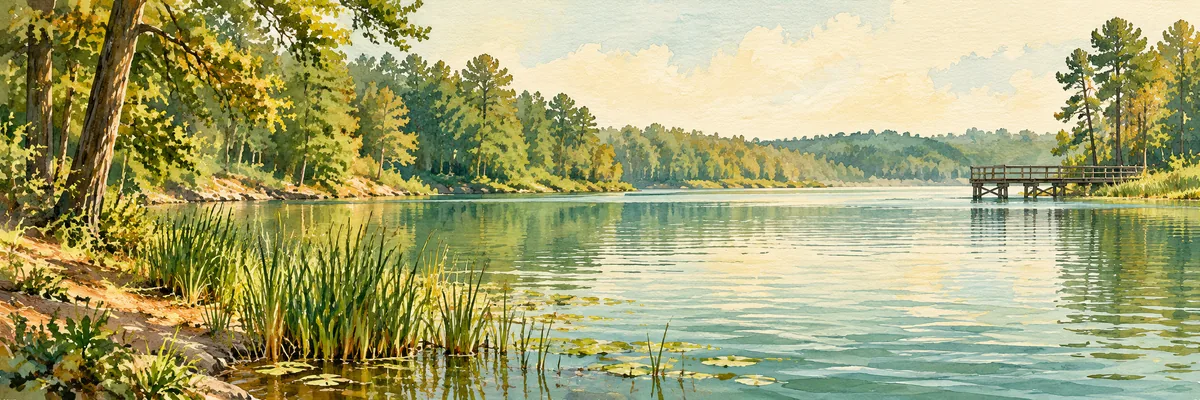
Caney Lake, also called Caney Creek Reservoir, is near Chatham in north Louisiana. A reservoir is a lake formed by holding water behind a dam.
Use the Caney Lake/Caney Creek Reservoir near Chatham and Jimmie Davis State Park names together when identifying this destination. A similarly named search result is not enough. Then choose a permitted shore position, own-craft outing or an actual confirmed guided service, each with its own access and return plan.
Use the right park information
Jimmie Davis State Park is an official starting point for investigating a lake visit, facilities or stay.
Check the particular fishing facility, launch or accommodation with its source/date, notices, hours, charges and permitted activity. Keep an access inquiry and a room or boat reservation separately. A page listing all three does not confirm any of them for the chosen date or establish a guided service.
Save the actual entrance, parking and shore approach or launch/boarding point, not only a lake pin. Include carrying bags, the usable fishing position, breaks/facilities and the route back. If the chosen facility is unavailable, another shore or ramp needs its own access answer.
Confirm the actual approach to your fishing position. Bank fishing means fishing from land; a pier extends over the water. A boat ramp serves a different job.
Understand what lies below open water
A reservoir can have slopes, old channels and changes in bottom shape even when there aren't obvious trees to cast beside. Anglers call that structure.
Cover is an object or plant feature, such as brush or vegetation. It can sit on a slope, so the two ideas aren't competing descriptions of the same thing.
A chart or appropriate depth-finding equipment can help interpret bottom shape when its reference/settings are understood. Keep bottom depth, fish position and bait/lure depth separate. A bottom feature or display does not automatically identify fish or establish a usable boat route; a surface view may leave the submerged extent unknown.
For an illustrative learning question, ‘the hook returns carrying plants’ describes an observed result. It does not establish total depth, a fish position or why a bite did not happen. A helper can compare the known setup’s path and adjustment before changing several parts. Electronics are not a prerequisite to a manageable shore visit, and buying them does not replace craft/route instruction.
Choose a setup you understand
Tell the guide or fishing-equipment shop where you'll fish and what you'd like to practice. Casting a small lure and watching bait below a float are different jobs.
A lure is artificial; bait is natural food on a hook. A float, cork or bobber is a surface marker with hook/bait below it. Learn the complete release/stop/cast-or-lower/watch-or-move/retrieve sequence for one setup, plus the actual hook response. Retrieve means bringing line back with the reel. Have unfamiliar controls, landing and unhooking demonstrated or assigned before a fish is caught.
Repeated lure retrieval and waiting beneath a float are different practice jobs. State which you want to learn, how instruction/turns work and whether the planned position is seated or standing. A clear-water description or catch photograph does not determine those arrangements.
Don't choose a fixed line size, lure color or depth only because an article calls Caney a clear-water lake. Have someone explain how your rod, reel, line, hook and any weight or lure work together for the activity you've chosen. The freshwater-rigs lesson shows those arrangements.
Plan the boat or shore day completely
For shore fishing, keep supplies portable and assigned: the known setup, water/food, layers/personal items, handling help/equipment and contained rubbish/line. Establish the actual rest/facility route and finish/return before deciding the length. The bank-fishing article follows a complete manageable session.
For your own craft, identify launch, parking, operation/route preparation and recovery/return, with suitable help for unfamiliar jobs. If investigating a guide, establish an actual Caney service, assigned boat, guest count, method/instruction, quote and departure/return. A park stay is not the pickup instruction or a confirmed fishing booking. Keep the proposal unanswered until the provider’s actual service is established.
Check the Louisiana Department of Wildlife and Fisheries' freshwater information for the relevant conditions before keeping fish, as well as your personal license requirements.
Keep one useful observation
From the permitted position with a suitable setup and help where needed, note the landing point and subsequent line/float/lure path. Retrieve and inspect before repeating. If plants repeatedly come back, compare one clearer cast path with the same equipment and movement, then describe the result rather than assume a different lure color solves it.
Keep place/time · visible feature · setup and movement · returned result · next question. A clearer return is something you can compare; it is not a catch prediction or proof that fish are absent. Avoid changing cast path, weight and movement together while learning what each changes.
Before starting, agree release or lawful keeping and the help needed for identification/handling. If keeping fish, establish cleaning, charge, packaging, collector/time/place and cold transport; do not infer those services from a park or guide label. Assign rubbish/line removal and wet-equipment cleanup before the next water.
Keep access/requirements still open beside the plan and revisit affected items for a changed date, facility, group or service. The freshwater checklist helps retain the full start-to-return jobs, while the observation note gives the next learning question.