
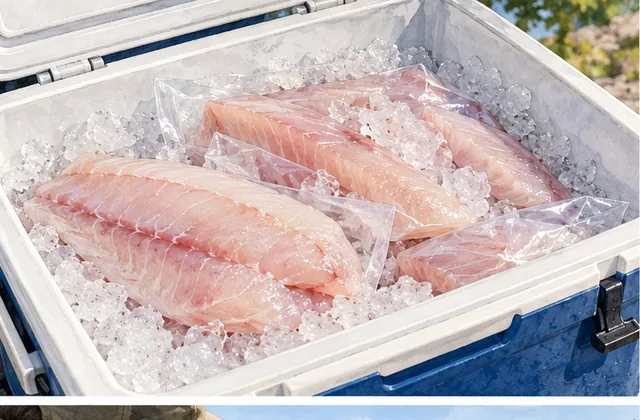
A cooler, also called an ice chest, is an insulated container. It slows the exchange of heat, but it doesn't make its contents cold by itself. You need suitable ice or cold packs and a plan for the whole journey.
Arrange the container, cooling supplies and next storage place before the trip. The boat's fish box may look after the catch aboard without supplying a container for your drive home. This page helps you prepare that equipment; the transport guide connects it to the full route.
Separate the jobs
Think about three places:
- On the water: who holds and cools any fish you keep, and where.
- At collection: whether you receive whole fish, fillets or other portions, chilled or frozen.
- During travel: who supplies the container and cooling, and where the fish reaches its next suitable storage.
A fillet is meat cut away from the backbone. Its packaging and handling differ from a whole fish, so ask what you'll actually collect. Confirm the collection place, ready time and whether the fish will be chilled or frozen.
If friends leave in different cars, name each share and destination before dividing packages. Each recipient needs suitable storage; one cooler doesn't solve several separate journeys. Keep the species, origin and collection details with each share, including required records. Personal labels help organization; they don't replace official documentation.
Keep the catch separate from ready-to-eat food. A drink cooler that everyone opens throughout the day has a different job from storage for raw fish.
Ask what the boat or cleaner provides
Before bringing a large cooler aboard, check the operator's arrangements. It may need to stay with your vehicle until the return.
Ask separately about ice, bags, sealed packaging and freezing: included, extra or not provided? Name who brings anything the service doesn't supply and when they obtain it. ‘Ice available’ still leaves the location, collection time, amount offered and cost to confirm. Don't leave the missing supplies to whoever happens to drive.
If freezing is arranged, check when the fish will be ready; don't schedule collection as though cleaning and freezing finish at the same moment. Keep the requested service and expected ready time separate from what is actually ready at collection.
If your group handles its own catch, decide who has learned the handling and storage method and who brings the equipment for it. Arrange that before fishing.
Prepare the container and route
Use a clean container in good condition. Ask about package dimensions and whether whole fish, fillets or frozen portions will be handed over. Check the usable space inside the container, including room for the cooling material and the intended packing arrangement. A cooler's advertised capacity alone doesn't show whether those packages fit.
Before leaving, rehearse loading and closing the container with clean stand-ins for the expected package shape. Check that the lid closes, the container fits its secured travel position and the person collecting it can move it. This checks the arrangement, not how long the fish will remain properly stored. Choose the packing and temperature-checking method using the container instructions and the FDA guidance below. Have the needed supplies ready before collection; don't size the cooler around a promised catch.
Match the supplies to the actual sequence: collection, waiting for friends, any meal stop, the drive, overnight storage and the destination. Name who checks the storage conditions and where replacement supplies can be obtained. If a delay adds a night away, confirm that night's storage and revise the supplies; don't simply extend the original plan.
Keep the cooler secured during travel and protected from unnecessary heat. Use a separate place for drinks so the fish container isn't repeatedly opened for snacks. Use the planned temperature check rather than judging the arrangement from visible ice alone.
Know what happens at the destination
Confirm usable refrigerator or freezer space if you're staying away from home. A room listing that says “mini-fridge” doesn't establish enough appropriate storage for your group.
The cold chain means keeping perishable food properly cold through every handoff. A sealed bag or vacuum pack doesn't create that chain; it still needs suitable storage.
Read the FDA seafood guidance before choosing your arrangement: use its temperature, handling and storage instructions for the fish you collect. For each handoff, name the next storage place and who gets the fish there. Check that the space is available when you arrive and can accommodate the actual packages. ‘A fridge is available’ leaves those questions open. If a hotel cannot provide what you need, resolve that before collection rather than relying on an unconfirmed fridge.
For a flight or shipment, ask the carrier first
Choose the container and cooling material only after checking the actual airline or shipping service's requirements. Confirm the packed size and weight, accepted materials and labeling for the booked service before paying for preparation. The transport guide covers the itinerary and handoffs.
Don't assume loose ice, gel packs, dry ice or a taped cooler are treated the same way by every service. Dry ice is a different cooling material with its own handling and carrier conditions; don't add it casually as an alternative to ordinary ice.
Keep the carrier's answer with the container plan and booked service. A packing service's offer doesn't itself establish carrier acceptance. Include cooling arrangements before check-in and after collection at the other end; the container is only one part of that journey.
Check the catch rules before cutting or transferring fish
Possession concerns fish you have with you or hold under the applicable rules; it isn't necessarily identical to what you're allowed to keep in one fishing day.
Check requirements for the species, waters fished, landing, cleaning, sharing and route. Some rules need fish to remain identifiable or require particular documentation. Don't use a generic label template as proof of compliance.
Start with Louisiana fishing information and the other responsible agencies for your trip. Ask while the fish can still be handled as required, rather than discovering a condition after it has been cut up.
At collection, compare the actual packages and chilled or frozen condition with the arrangement you prepared. If the quantity, package size or ready time differs, resolve the fit, supplies and next storage before departure. Keep the collector, required records and next storage place with each share; the dock-to-dinner guide follows that handoff through to the meal.