
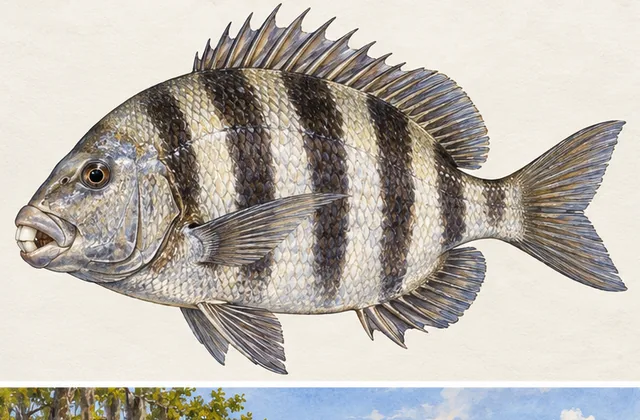
Sheepshead are coastal fish with dark bars across a silvery body and front teeth that look surprisingly like our own. They eat animals such as crabs, barnacles and oysters, which helps explain why anglers look for them around shell-covered objects in the water.
You might encounter them on a Louisiana inshore or nearshore outing. You don't need to know every rig name to follow the fishing, but it helps to understand what the bait is supposed to do.
Recognize the fish before the fishing method
The bars are a useful first clue. Young black drum have bars too, so stripes alone don't settle the name.
A sheepshead's body is tall from back to belly but relatively thin when viewed head-on. It has strong fin spines—the stiff, pointed parts of the fins. Black drum have barbels, the whisker-like feelers under the chin. The illustrated sheepshead profile shows the fish's features together.
Look at the reference before fishing and compare the body, fins and chin features together. A sheepshead-focused booking doesn't identify every striped fish caught. Ask for identification help before a keeping decision if the comparison remains uncertain.
You can learn about the teeth without putting a finger into a fish's mouth, and sharp fins need care when bringing a fish within reach and removing the hook. Have the landing and hook-handling process demonstrated before the first catch.
Why anglers talk about pilings and shell
A piling is a post supporting something such as a dock or bridge. Shellfish and other small animals can grow around these objects. They give sheepshead food to investigate.
You'll also hear about rocks, oyster reefs and coastal platforms. These are examples of habitat, rather than instructions to approach a bridge, climb onto rocks or scrape a surface for bait. Start with a permitted fishing position that gives you room to work.
In fishing conversation, these objects are often called cover. Structure more specifically means the shape of the bottom. A visible piling doesn't establish bottom depth or a fish beside it. Identify the feature you can see and the bait path you want to investigate; keep boat positioning and moves with the operator's directions.
Learn what your bait is doing
A small piece of shrimp is one bait you may use. A rig is the hook, line, weight and other parts arranged at the fishing end. A sinker adds weight; a jighead combines a weight and hook.
With a known setup and appropriate help, first learn the controls for placing bait, stopping line and bringing it back. A cast sends bait out with the rod; a controlled lowering releases it beside the fishing position. Establish which action the method uses, then follow the demonstrated sequence:
- Put the bait into a clear, reachable path beside the feature, with space to work and a clear return.
- Follow the line after placement and stop or move it as shown for that setup.
- Watch and feel changes in pull through the rod. That pull is called tension; learn the hook response before relying on the feeling.
- Retrieve—bring the line back with the reel—before it reaches an obstruction or becomes unmanageable, and at the checks you've been shown.
- Inspect the bait, hook and line before another attempt.
A light tap can be hard to notice. On return, check what you have: bait still attached, an empty hook or tangled line? Those observations help an instructor explain the attempt, but don't identify which fish was there. Have the bite response demonstrated for your actual hook. The hook-shape lesson explains why a circle hook and a J hook aren't always used the same way.
If the hook keeps catching the feature, bring the setup back and inspect it before repeating. A snag is a hook caught on an object; ask for help if you can't recover it under control. Compare a reachable path slightly farther from the object with the same setup and movement, rather than change weight, bait and path together.
For an illustrative note, ‘first return had a bare hook; second had bait still attached’ records bait condition, not which fish was present. Likewise, debris on the hook is not a measured depth or proof the area has no fish. The coastal-rig lesson explains the parts.
Put a first outing together
For a guided day, ask whether sheepshead are the focus or one possible catch, and whether guests cast or lower bait beside the boat. Establish demonstrations, supervised attempts, turns and who helps with bait, tangles and hooks. A supplied rod or species label doesn't establish individual teaching.
Keep that activity with the actual boat, departure, guest positions, whole schedule and full-group price, including any extra services. If the method, boat or date changes, revisit the affected help, facilities and travel arrangements. For an independent visit, choose a permitted position, learned setup and manageable return with landing help arranged.
Check Louisiana's saltwater rules for the actual fish, water, date and outing, alongside personal requirements. Agree who brings a fish within reach, identifies and measures it, handles the hook and manages release or lawful keeping. Prepare tools and help before starting rather than improvise around teeth and spines.
If keeping fish, arrange preparation, charges, collection place and time, collector and cold transport. Allow for those finishing jobs after the fishing. You can leave a first outing knowing the fish and the method even if learning the bite takes a few tries.