
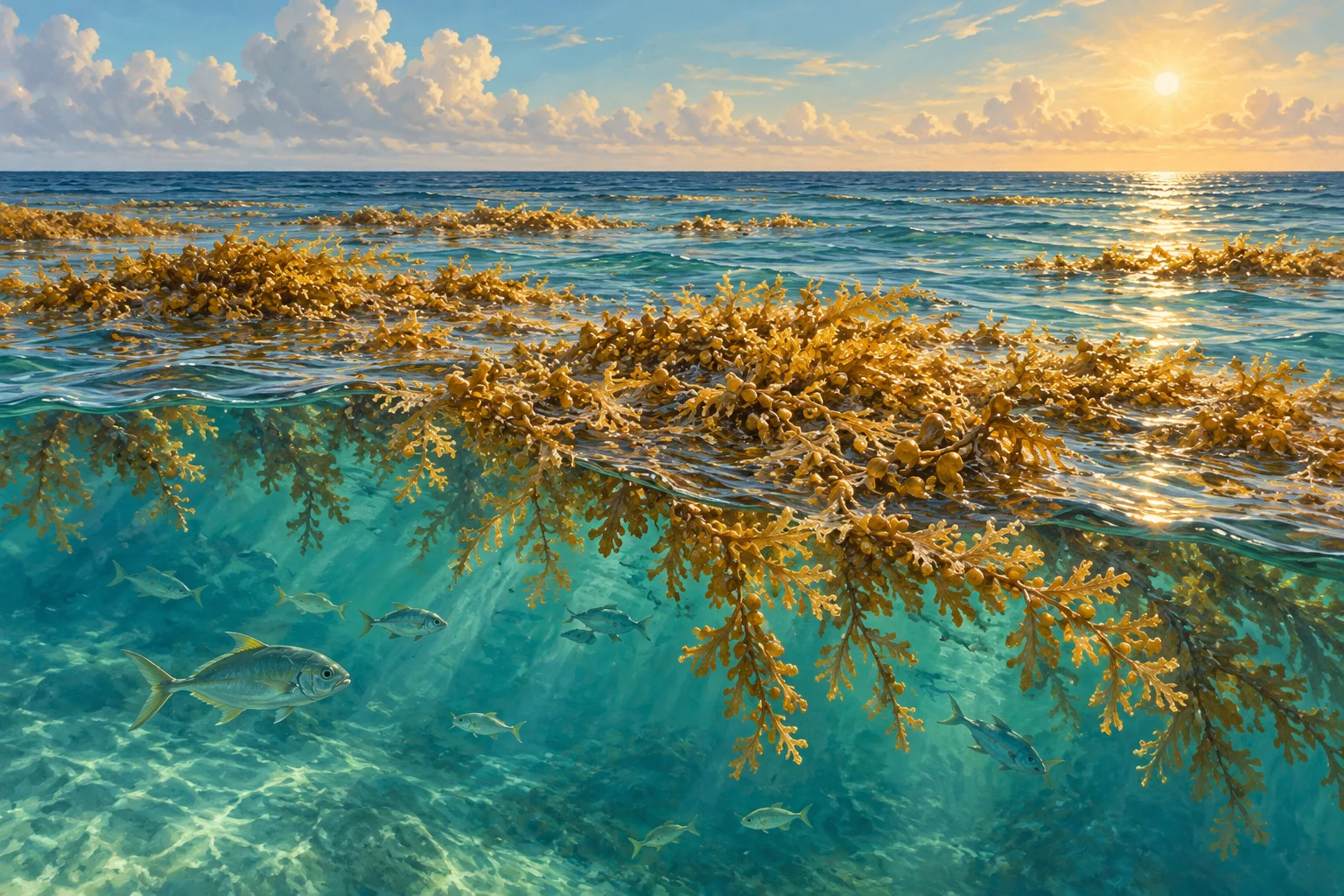
Sargassum is brown seaweed that can float at the surface of the Gulf. From a boat, you may see a few clumps, a broad patch or a long band of it.
It provides habitat: a place animals use for food and shelter. Small animals use the vegetation, and larger animals may visit to feed. That's why a patch interests both anglers and wildlife-watchers, and why it should be treated as more than debris in a boat's way.
What is living around it?
The National Oceanic and Atmospheric Administration's Sargassum introduction describes its role as habitat for fish, turtles and invertebrates—animals without backbones, such as crabs and shrimp.
A food web is the network of animals eating plants or other animals. Floating vegetation can give small animals shelter and food, with other fish investigating the same area. That relationship explains the habitat's importance; it doesn't mean every clump holds the same animals or an immediately visible predator.
Mahi-mahi are one fish anglers associate with floating cover. A patch may contain much more than the fish someone hopes to catch, including sea turtles.
Why does it form a line?
A weedline is a band of floating vegetation. Moving water, called current, can gather vegetation and other floating material along a surface boundary.
That line is something you can observe. It doesn't tell you the depth of the seabed or identify everything underneath it.
The boat can be over deep water while animals and fishing activity are near the surface. Keep bottom depth, intended bait or lure level and evidence of fish position as separate questions. A visible weedline supplies none of those measurements by itself, which helps explain why a crew may cast beside floating cover instead of lowering bait all the way down.
Keep the place and time with an observation or photograph. A moving patch seen earlier is not a confirmed location for a later visit, and absence of a visible fish is not an inventory of the habitat.
Watch before the first cast
From a suitable boat position managed by the operator, look along the edge. Notice whether you're seeing isolated clumps or a band, which way it moves relative to the boat and any animals actually visible. A change in relative position doesn't by itself measure current speed or explain every animal's movement.
Observation can be the whole activity. An illustrative note might say ‘a band of brown vegetation; small animals visible at the edge; species not identified.’ Keep the visible features, uncertain identity and question separate rather than list everything that might use Sargassum as if you saw it there.
If fishing, have the actual setup, casting space, movement, hook response and return demonstrated under the crew's direction before sending a hook out. Choose a reachable clear path beside the vegetation. A cast sends your line and lure out with the rod. A lure is artificial bait; its retrieve is the movement back toward you with the rod and reel.
Try a short, controlled cast using known equipment and appropriate help. Follow the line and lure after landing, retrieve before an obstruction or loss of control and inspect the return. If it collects seaweed, pause and have an unfamiliar hook-clearing job demonstrated before handling it.
Compare one slightly clearer path while keeping setup and movement the same. An illustrative note, ‘first return carried weed; second returned clear,’ describes the attempts, with catch or no catch separately. It doesn't measure depth or prove fish absence. Change one path before changing rod, line and lure together. The casting lesson explains the first movement.
Keep hooks away from turtles and other wildlife. Seeing an animal doesn't make it a target or a reason to gather everyone close to it.
Keep the habitat and the boat in mind
Leave the seaweed in place, collect loose fishing line and contain rubbish. If vegetation fouls boat equipment, let the operator deal with it using the boat's appropriate procedure; don't reach toward moving machinery.
For a guided trip, establish whether the goal is habitat observation, casting beside floating cover, trolling or another method. Trolling means pulling baits or lures behind a moving boat, with different guest jobs from repeated casting. Ask about demonstrations, supervised attempts, turns and wildlife observation rather than assume a Sargassum mention includes every activity.
A weedline can move or be absent. Choose the offshore day for the actual activity, ride, facilities, hours and group needs. Ask how a proposed change affects the observation or learning goal and connected travel; another method is not automatically the same experience.
Afterward, retain a small record of place and time, visible vegetation, movement relative to the boat, animals seen or unidentified, and one question. If you fished, keep the setup, action and result alongside it. Leave the habitat in place and complete the agreed cleanup. A useful visit can be a few careful observations without a cast or catch.