
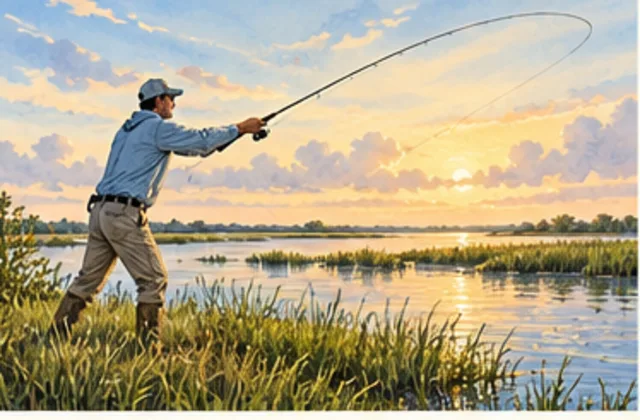
Casting means sending a hook, bait or lure away from you with the rod. A spinning reel lets line leave its spool while you cast, then winds it back afterward.
Use a practice plug—a casting-practice weight without a hook—or other hook-free practice equipment within the rod's printed casting range. That lets you learn the movement before adding a sharp hook. Your first goal is a short cast you can control and retrieve. Learn the preparation, release, return and reset as one attempt before working on distance.
Get to know the controls
A spinning reel hangs below the rod. Its spool holds the line, and the curved wire arm is the bail. Open the bail and line can leave; close it and turning the handle brings line back in.
Check that the line passes through all the rod's guides, the small rings along it, including the tip ring. A line wrapped around the rod or missing a guide can stop a cast working as intended. The setup guide explains the parts.
Have the instructor identify the bail, handle and drag control on the actual reel. Explain which control lets line leave and which action returns it to winding. Opening the bail and adjusting drag are different tasks; this lesson doesn't require changing a prepared drag setting. Other reel types release line differently; the sequence below is for a spinning reel.
Check that the hook-free practice weight is attached using an appropriate connection for the actual line and equipment. The knot lesson explains learning and inspecting a connection; a practice weight still needs a completed join.
Choose clear practice space
Use a suitable area with room in front, behind and overhead, away from people, animals, trees, wires and other obstructions. Check again before each attempt; clear space isn't something you establish once and forget.
On a boat, the crew decides where you can stand and cast. Start under their direction rather than assigning yourself a casting lane.
Pick a nearby, visible target in that clear space so you can compare where each attempt lands. Keep the same practice equipment and target for the first comparison. Agree when to stop and call for help, and let anyone sharing the area know before another attempt.
Try one smooth cast
Leave a short length of line hanging between the rod tip and practice weight, with the weight clear of the tip rather than pulled tightly against it. Have an instructor check that starting length for your rod and practice equipment, then follow the sequence:
- Hold the rod securely and trap the line against it with your index finger. Don't wrap the line around your finger.
- Open the bail while keeping the line held. The practice weight should stay hanging, not drop to the ground.
- Check the space again, including behind and above you. Move the rod back and then forward smoothly toward the nearby target.
- Lift your finger off the line during the forward movement so line can leave the spool. Start with a gentle movement while you learn that timing.
- After the weight lands, close the bail by hand. Turn the handle gently to bring in loose line, then wind the practice weight back toward you.
After winding back, pause to look for loose loops, a line wrap or a shifted connection before resetting the starting length. Name the next action—hold, open, cast and release, close or retrieve—if you lose track of the order.
Don't force the cast if something catches or the line won't run freely. Stop and check the setup with the instructor. The retained Ontario casting activity provides another illustrated learning reference.
Change one thing at a time
Use what happened to choose one thing to check:
- The weight drops when you open the bail: hold the line with your finger before opening it and keep holding until the cast.
- Line won't leave during the cast: stop. Check that the bail is open, your finger has released the line and the line isn't caught around the rod or a guide. Don't try to force it with a harder swing.
- The cast goes in an unexpected direction: keep the next attempt short and smooth. Have an instructor watch when you release the line instead of adding more force.
If loose loops collect around the reel, stop and keep the practice weight still while you sort them out. Winding harder can tighten the tangle. Ask for help if you can't see where the line is caught, then check its route through the guides before trying again.
For an illustrative direction problem, keep the same short target and practice weight while the instructor watches the release. Make the one timing correction they demonstrate, then complete the return and check before trying again. Changing target, force and equipment together makes it harder to understand the result.
Repeat the same order: hold the line, open the bail, cast and release, close the bail, wind back and inspect. A useful note names what happened, the correction tried and where the next attempt landed. Once the sequence feels familiar, work on landing nearer the target rather than immediately casting farther.
When you move from practice equipment to a hook or lure, have the instructor recheck the complete casting weight, attachment, starting arrangement and handling space. A new fishing end isn't automatically the same match as the practice weight. Learn the extra hook-handling and return checks before using it around other people.