
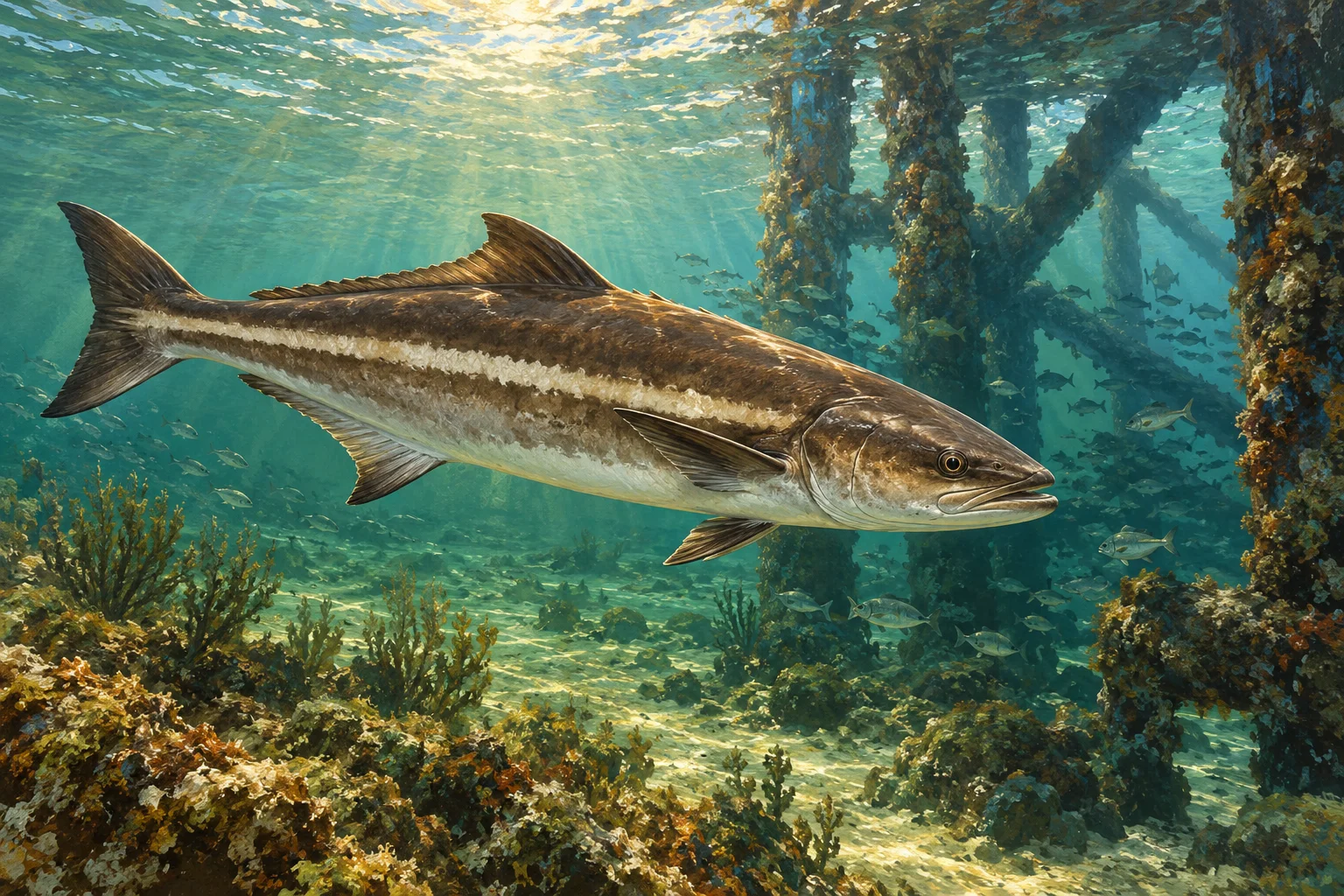
Cobia are long, dark-backed coastal fish that can be found in nearshore and offshore waters. Their shape can look a little shark-like at a glance, but cobia are a different fish.
An outing may involve looking for a visible fish and then making a careful cast. That is a different activity from dropping bait repeatedly toward the bottom, so it's useful to know what kind of fishing you're arranging.
Learn the shape and the name
The National Oceanic and Atmospheric Administration's cobia profile describes a dark-brown back, lighter underside and a long body. Cobia can be confused with sharks and other fish called remoras.
Look at the full reference before the outing and compare the whole fish, not only a dark shape near the surface. If a sighting is uncertain, keep watching or get identification help rather than let the advertised target supply the name. You don't need to bring an unfamiliar animal aboard to decide what it is. Recognition and a later lawful-keeping decision are separate questions.
Understand why people look near objects
Cobia eat fish, squid and crustaceans, animals such as crabs and shrimp. They may draw an angler's attention near floating objects or fixed features such as a buoy or platform.
Cover means objects or plants associated with the water. Structure means the bottom's shape. An offshore feature, a floating object and a coastal fishing position can involve very different boat days, even when the same fish name appears in the plan.
Treat the feature as something to observe from a suitable position, not proof of a cobia beside it. Its visible shape doesn't establish bottom depth, the bait's later path or a usable approach. A working buoy or platform has a purpose beyond fishing and isn't something to tie onto or crowd. Keep the boat's approach, position and moves with the operator.
Picture a sight-casting attempt
Sight casting means using the rod to send bait or a lure toward a fish or opportunity you can see. A lure is artificial bait; natural bait is food on a hook. Before trying it near a fish, learn the movement and how to bring the line back in the casting lesson.
Have the actual setup, casting space, bait or lure movement, hook response and return demonstrated before a fish appears. Use known equipment with appropriate help; distance is not the first goal. The sequence begins before the cast:
- Establish what you're looking at and watch its movement from the agreed position.
- Choose a reachable landing point and a clear path for the bait or lure and its return.
- Make one controlled cast, then follow the line and bait or lure after landing.
- Bring it back before the path reaches an object or another line, or becomes unmanageable.
- Inspect bait or lure, hook and line for tangles or damage before another attempt.
The aim is a clear path the moving fish may encounter, rather than repeatedly landing a lure on it. Ask the guide to point out where the bait or lure should hit the water and its path back before you cast. Practice a reachable, controlled placement before trying more distance.
Retrieve means bringing the line back with the rod and reel. Learn the movement with the setup you're using; a weighted lure and a natural bait won't necessarily travel alike. A landing point, later path and fish's movement are different observations.
For an illustrative note, ‘cast landed clear; line then moved toward the object; retrieved and chose a clearer path’ records the attempt and one change. Keep setup and movement the same while comparing that path. It doesn't measure depth, prove why a fish moved or establish that no fish are present.
Plan your part of the day
If you're new, establish demonstrations, supervised attempts, turns and bait, tangle and hook help. Find out whether cobia are a planned target or a possibility during a mixed-species day. Ask how much time is searching or riding, and what guests do when no fish is visible. A sight-casting interest doesn't promise a sighting or continuous casting.
Keep the method with the assigned boat, actual departure, guest positions, whole schedule and full-group quote, including extra or unanswered services. Describe the group's practical needs before paying. If the boat, method, area or date changes, revisit the affected help, facilities, price and connected travel.
Landing means bringing the fish under control within reach. Agree who controls the rod, identifies and measures the catch, handles hooks and manages release or lawful keeping, and where other guests stand. Let the experienced crew manage landing instead of reaching toward a moving fish or exposed hook. Ask how to request help or hand control back before a catch.
Use Louisiana's saltwater guidance and the applicable federal information for the confirmed species, water, dates and type of boat trip before keeping a catch. Check personal requirements separately. For lawfully kept fish, arrange preparation, charges, who collects the fish, the collection place and time, and cold transport; those finishing jobs follow dock return. Learning to recognize the fish and make a controlled attempt is a useful result without a promised catch.