
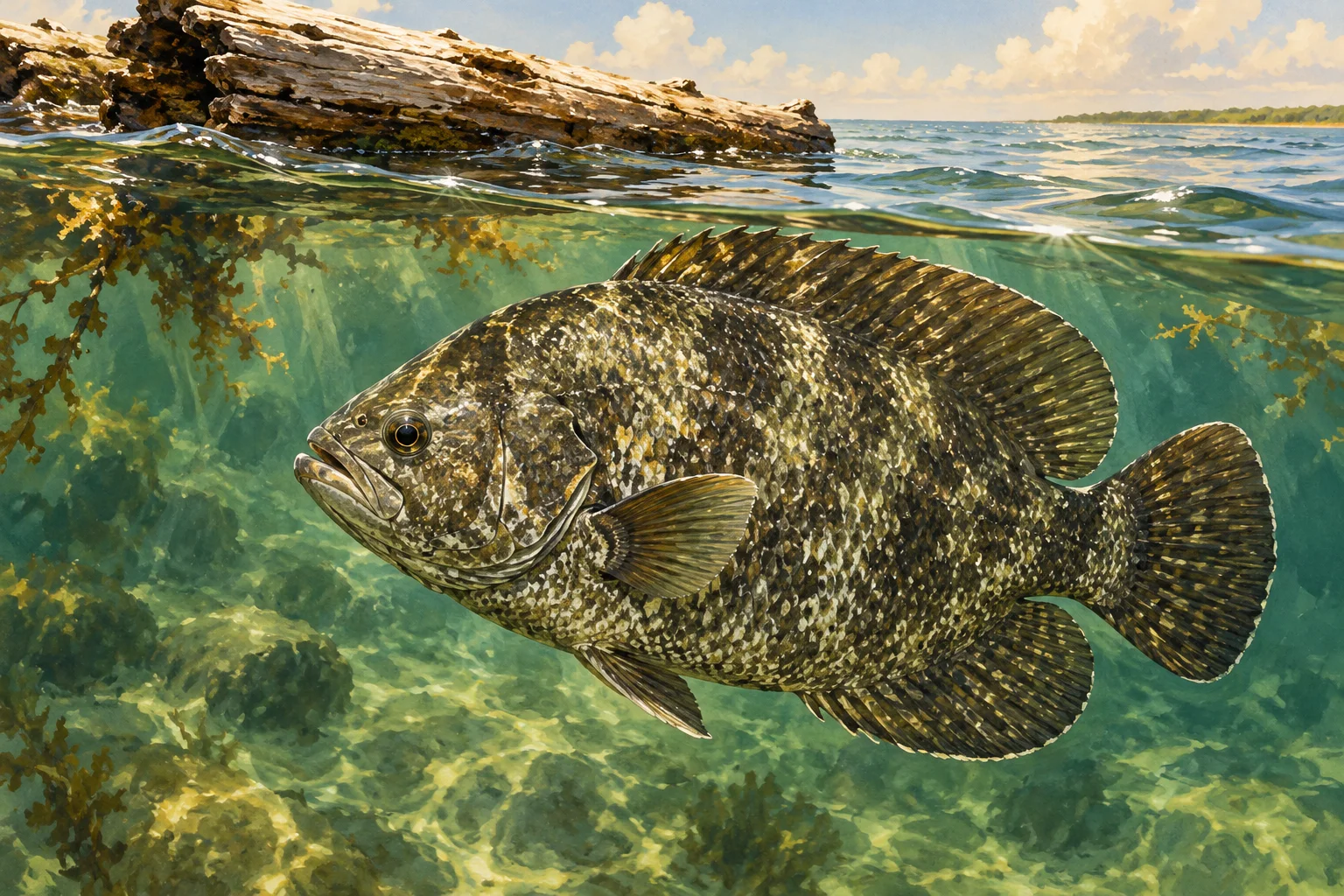
Tripletail are coastal fish named for the way their fins make them look as though they have three tails. The real tail and the rear parts of the top and bottom fins sit close together, creating that unusual outline.
They can lie near the surface beside floating objects and look surprisingly like drifting debris. For a beginner, part of the interest is learning to notice the fish before making a cast.
What am I looking at?
Tripletail have a body that is tall from back to belly and flattened from side to side. They can show mottled coloring—irregular patches rather than one even shade. The illustrated tripletail profile shows the fin arrangement behind the name.
A dark shape beneath a float isn't automatically a tripletail. Pause and look for a body, fins and movement. A fish lying at an angle near the surface isn't necessarily injured; that appearance is part of what makes tripletail unusual.
Look at the profile before the outing, then use the fin arrangement, body and markings together with experienced help if needed. An advertised target or debris-like shape is not a complete identification. The profile supports recognition; use the applicable Louisiana guidance separately for fishing rules.
Why floating objects matter
Floating cover can mean drifting vegetation or another object at the surface. Tripletail are associated with that cover in bays and offshore water, where they feed on smaller animals.
Current is water moving in a direction. Watch naturally loose vegetation or a fishing float to follow surface movement; that is not a measured speed throughout the water. Shade and moving water aren't the same thing: bait can drift out of the shadow even while the boat appears to stay beside it. Visible cover doesn't establish bottom depth or a fish underneath.
A buoy is a floating marker; some mark traps or other working gear. Leave the object and its lines undisturbed. Have the boat operator identify the space available for the cast while managing the approach, rather than treating every floating object as a place to tie up.
Follow a bait below a float
A float, also called a cork or bobber, sits on the surface while a baited hook hangs beneath it. It gives you a visible reference for where the setup is traveling.
Have the instructor identify the parts and show the float-to-hook distance, intended bait level and path, line control and hook response. That distance helps set the arrangement, but current and line angle matter too. The float is a surface reference; its position is not the exact hook location or a bottom-depth measurement. No single spacing fits every object or outing. The float-rig guide explains the parts.
For a first lesson, have the setup, cast and return demonstrated before trying it near a fish. Use known equipment and appropriate help, with a reachable placement and clear path back. Then follow one attempt:
- Place the bait where it has room to drift toward the area you're watching.
- Follow the float and line instead of immediately making another cast.
- Bring the setup back after it passes the intended area or before it drifts toward working gear or another line.
- Inspect bait, hook and line, and have tangles or damage dealt with before trying again.
If the line catches on working gear, stop and tell the operator rather than reaching over the side to free it. A float dipping or changing direction doesn't identify the cause by itself; use the demonstrated response for the actual hook.
For an illustrative comparison, keep the setup the same while trying one clearer placement. Record where the float landed, where it traveled and the returned bait or line condition, with catch or no catch separately. Changing float spacing, bait and placement together makes that comparison harder to explain; an empty hook alone doesn't identify the fish that may have been there.
Choose a learning outing
Ask whether searching floating cover is planned or simply a possibility during a broader coastal day. Explain that you'd like time to learn the cast, drift and fish features. Establish demonstrations, supervised attempts, turns and who handles bait, tangles and hooks; a rod supplied to each guest doesn't establish individual teaching or simultaneous casting space.
Keep the actual activity, boat, departure, positions for riding, fishing and resting, hours and full-group price together. Searching and riding are parts of the day too. If the method, boat, area or date changes, check the affected help, facilities and travel arrangements before treating the alternative as equivalent.
Before keeping a fish, confirm its identity and check Louisiana's saltwater rules for the actual outing, with personal requirements checked separately. Agree who brings the catch within reach, identifies and measures it, handles the hook and manages release or lawful keeping. The landing lesson explains those jobs.
For lawfully kept fish, arrange preparation, charges, collection place and time, collector and cold transport before the journey. Dock return isn't automatically readiness to leave after the handoff. You can learn the three-tail outline and follow the bait's path without rushing another cast or needing a promised catch.