
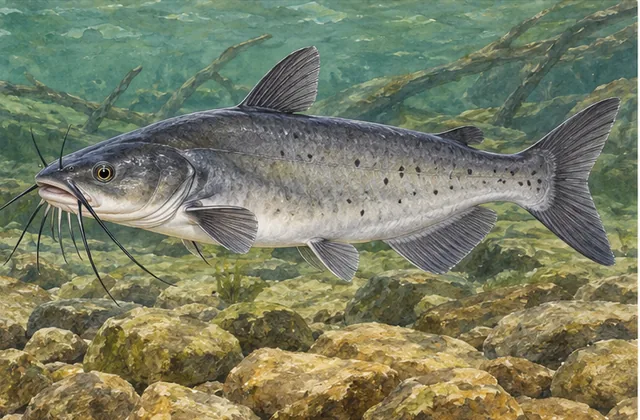
Catfish are fish with whisker-like feelers called barbels around the mouth. The barbels help them sense their surroundings; they're a useful reason behind the familiar name.
Louisiana anglers commonly discuss blue, channel and flathead catfish. Those are different species, and a coastal “catfish” can be something different again. This introduction is about the familiar freshwater fish, rather than a trip to chase the biggest possible catch.
Get to know the main names
Blue catfish and channel catfish both have forked tails. Compare body and fin features together using an identification reference; a forked tail or bluish color alone doesn't identify a blue catfish.
Flathead catfish have a broad, flattened head and a tail that isn't deeply forked like those two. You may hear local names such as “yellow cat.” Don't turn a nickname into a keeping decision without confirming the species.
Some coastal catfish have different handling concerns from the freshwater fish you meant to catch. Learn the reference before the outing and compare the actual body, fins and tail with experienced help if uncertain. Whiskers, a target name or a local nickname don't make the fish interchangeable or establish lawful keeping.
Picture a bait-fishing activity
Natural bait is food placed on a hook, rather than an artificial lure. A bottom rig uses a weight and hook arrangement to put the bait on or near the underwater floor.
You might cast the setup from a permitted bank or lower it from a boat. Have someone identify the actual rig parts and show how to release and stop line, place the bait, watch the line and rod tip, respond with the actual hook and bring the rig back. A setup intended to hold bait is not automatically worked like a moving lure. Learn those controls and how to ask for help before a bite.
A leader is a separate piece of line near the hook. Worms, shrimp and pieces of fish are among the bait choices you'll hear discussed; the right choice also depends on bait rules for your water.
For a first attempt, use known equipment and appropriate help from a suitable permitted position, with casting space and a clear return. Place the bait in a reachable open area and follow line movement and the rod tip as demonstrated. A changed pull may involve fish, moving water or an obstruction; it doesn't diagnose the cause by itself.
Retrieving means bringing the line back with the reel. Retrieve as demonstrated and before an obstruction or loss of control. Inspect bait, hook, line and any tangle; if bait is missing, have replacement and hook handling shown before repeating. The freshwater-rigs guide explains the arrangements.
For an illustrative note, ‘bait missing on return; hook and line checked; bait replaced with help’ records the result and next job. It doesn't identify the animal involved or establish fish absence. If comparing a different path, keep the rig and bait presentation the same rather than change several parts together.
Choose water you can actually fish
A lake bank, pond visit and moving-river boat outing are different tasks. For shore fishing, establish a permitted position with room to cast and bring the catch under control.
A river's current is its flowing water. Fishing from a boat there means managing the boat as well as the bait and line. If you're still learning to cast and manage bait, a permitted bank or pond visit lets you focus on those skills first.
The Louisiana Department of Wildlife and Fisheries' Get Out & Fish locations can help investigate a community visit. The Red River recreation information covers a different setting. Confirm the named site, manager, permitted activity, approach, hours and facilities; neither broad reference supplies today's access or instruction at every position.
On a guided day, establish the species focus, bait method, demonstrations, supervised attempts, turns and handling help, with actual boat or bank, hours and full-group price. For an independent visit, prepare the permitted position, known setup, landing help and complete return. A large-river target and a short beginner bank lesson need not be equivalent offers.
Arrange help before handling a fish
Catfish can have stiff, pointed parts in their fins, called spines, as well as an exposed hook near the mouth. The sensing barbels and fin spines are different parts of the fish. Don't pick up an unfamiliar fish by copying a grip you haven't learned.
Landing means bringing a fish under control so it can be unhooked. On a guided day, ask the crew to explain who handles each step and what you should do while they work. On your own outing, learn the appropriate method with competent help and suitable equipment before it becomes urgent.
Deliberately seeking a large river fish needs a different landing space and plan from a short beginner visit. You don't need that challenge to start learning bait fishing.
Separate keeping rules from eating advice
Check the agency's freshwater information for the species and water, along with personal licensing conditions.
If fish are lawfully kept for food, check Louisiana's Eat Safe Fish advice for the actual species, place and people eating it. A keeping rule is not a consumption assurance, and another waterbody's advice doesn't answer this one. The consumption-advice guide explains how to read the source; no general size nickname establishes food quality or suitability.
Agree identification, measuring, hooks and release or lawful keeping before fishing. For kept fish, resolve preparation, charges, collection place and time, who collects them and cold transport. Include cleanup and collection before the journey home; dock return or the last cast is not automatically readiness to leave.
Pack drinking water, a way to collect discarded line and the tools you've learned to use. You can keep the first visit short while you get comfortable with the bait, cast and catch-handling steps.