
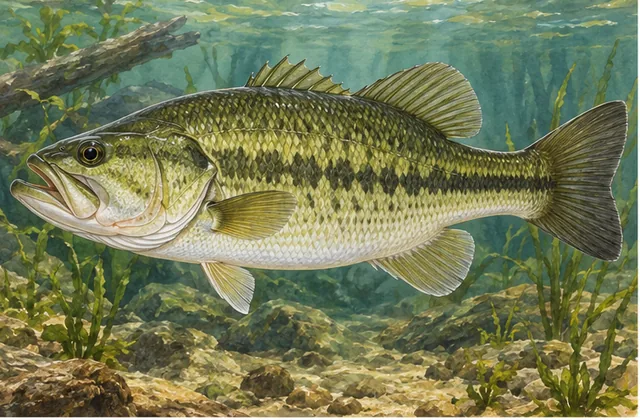
Largemouth bass are freshwater fish found in lakes, reservoirs, bayous and river systems. When someone says they’re going bass fishing in Louisiana, largemouth is often the fish they mean. Spotted bass are another member of the black-bass family.
Striped bass and white bass are a different group, so ask which fish and activity a listing means. You don't need to know every bass name before arranging a first lesson.
Recognize the fish and the setting
Largemouth bass have a broad mouth and often show a darker band along the side of a greenish body. Color and markings vary; the name or one feature isn't a complete identification.
Read the fish-identification introduction before the outing, then compare the features actually visible on a catch, with experienced help if uncertain. A bass-focused booking doesn't identify every fish or establish its keeping conditions. Leave unseen details unknown rather than fill them from the target name.
A reservoir is a lake held back by a dam. A public-bank visit, your own boat on a lake and a guided river trip involve different access and equipment. Choose the actual activity and permitted place as well as the fish.
Understand cover and structure
Cover means objects or plants in the water, such as branches, grass or dock posts. Structure means the bottom's shape, such as a slope or the edge of a channel.
Bass fishing often involves placing bait or a lure around those features. That doesn't mean a fish sits beside every tree or that the nearest private dock is available to fish from.
From a suitable permitted position, identify one visible feature and a reachable path beside it. Seeing grass or a post doesn't establish the bottom slope, depth or fish position. Keep the cast's landing point separate from where the line travels afterward; on a boat, keep positioning and moves with the operator. The cover-and-structure lesson explains the words with a drawing.
Picture a simple lure-fishing activity
A lure is an artificial object used to attract fish. Casting sends it out with the rod; retrieving brings it back with the line and reel.
A soft-plastic lure can imitate a small fish or another animal bass eat. Have its hook arrangement, casting movement, line control, return and hook response demonstrated with the actual setup. From a permitted bank with room to cast and a clear return, try a short cast beside vegetation and bring the lure back at the demonstrated steady pace. Follow its path after landing and retrieve before an obstruction or loss of control. Begin with a known setup and appropriate help before trying more distance.
Bring the lure back and inspect the hook and line before casting again. Ask for help clearing the hook or untangling the line if you haven’t learned how. If it collected grass, try a path slightly farther from the vegetation while keeping the lure and return movement the same. Compare whether it comes back clearer. Our soft-plastics lesson explains the lure and hook arrangement.
Keep bottom depth, the lure's path and any evidence of fish position as three questions. A lure running above the bottom is doing a different job from one dragging through it; returned grass is a result to inspect, not a depth measurement.
For an illustrative comparison, record ‘same lure and steady return; first path carried grass; clearer path returned clean,’ with catch or no catch separately. That compares one path change without proving fish absence or a new fish location. Begin with control before adding distance or another color.
Choose a learning day that fits you
Tell a guide one useful goal: learning to cast, understanding a lake feature or becoming comfortable with a reel. Establish demonstrations, supervised attempts, turns and bait, tangle, landing and hook help. Separate gear supplied from instruction and services included in the price. A rod for every guest doesn't establish personal teaching or simultaneous casting space.
Keep the activity with the assigned boat or bank, actual meeting point, positions for riding, fishing and resting, hours and full-group quote. Discuss practical needs before paying. If the water, method, boat or date changes, revisit the affected help, facilities, requirements and travel arrangements.
The Toledo Bend and Caney Lake pages introduce reservoir visits; the Atchafalaya Basin introduces a connected-water setting. These places need their own actual access or departure, not one shared meeting point or promise of a particular fish size.
The Louisiana Department of Wildlife and Fisheries' fishing workshops are another place to investigate instruction. For a guided lesson, confirm what fishing gear is supplied before buying equipment.
Keep the rules and return clear
Use the agency's freshwater information for your actual water and catch conditions. Some lakes and border waters have their own conditions, so look up the place as well as the fish.
Check personal fishing requirements separately from catch conditions. Before fishing, agree who brings a catch within reach, identifies and measures it, handles the hook and manages release or lawful keeping. The landing lesson explains those jobs.
For kept fish, arrange preparation, any charges, collection place and time and cold transport. Include those jobs, collecting equipment and rubbish, and the walk or ride back before onward travel. A short practice session is useful without a promised catch.