
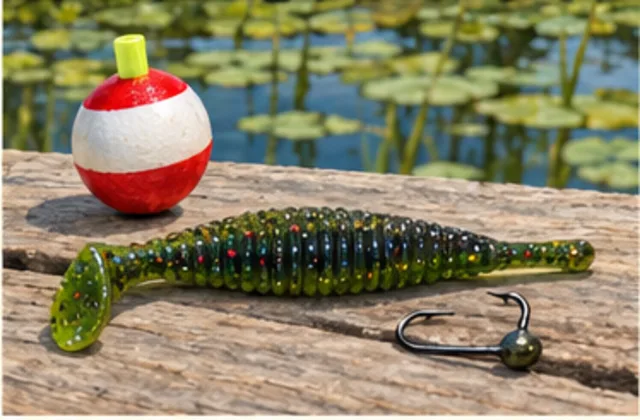
A popping cork is a float with bait or a lure hanging below it. Give it a short pull with the rod, then pause. The cork disturbs the surface while the bait or lure moves beneath it. Watch the cork for a change that may be a bite.
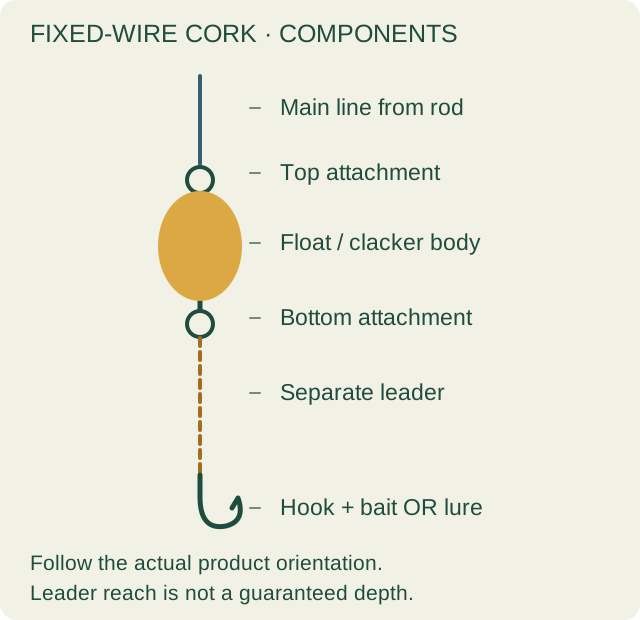
This lesson uses a fixed-wire cork: a float on a wire stem with an attachment at each end. Line from the reel ties above it; a separate length called a leader ties below it. Unlike a slip float, this cork does not slide along the main line.
Follow the line from rod to hook
A rig is the arrangement at the fishing end of the line. Trace this one in order:
Line from the reel → upper attachment → cork assembly → lower attachment → leader → baited hook or lure.
The attachment eyes are the small loops where you tie the line. Use either the baited hook or the lure chosen for your setup, rather than adding both because they appear in the diagram.
 Open the full-size illustration →
Follow the product's intended top and bottom. Beads and moving parts belong to the cork assembly; they are not extra places to tie the line.
Choose parts that work together
Choose the baited hook or lure you want to fish with, then a cork that can support it. Too much weight can pull the float under before a fish touches the bait. Count the whole rig—including the float—when comparing it with the rod's casting range. The rod, reel and line guide explains those equipment labels.
Leader length changes two things: how far the hook can reach below the cork and how much tackle hangs from the rod during a cast. Finished length is the distance from the lower attachment to the hook or lure after tying. Cut extra line for the knots.
Keep the hook from continually dragging through grass or along the bottom. If it collects plants, try a clearer path first. If the leader still reaches into them, shorten or replace that separate piece of line. This design does not adjust by sliding the float up the main line.
A longer leader gives the hook more reach but leaves more tackle hanging during the cast. Use a length you can cast and retrieve under control. Moving water pulls the leader sideways, so its length is not an exact reading of the bait's depth.
Assemble the fixed-wire rig
Lay out the cork, main line, leader and chosen hook or lure. Set aside bent wire, damaged eyes or frayed line. If knots are new to you, practice a suitable connection with the knot lesson first; it needs to suit the actual line and attachment.
- Connect above the cork. Tie the line from the reel to the product's upper attachment eye.
- Connect below it. Tie one end of the leader to the lower eye, hanging free of the stem and fittings.
- Add the fishing end. Tie the chosen hook or lure to the leader's other end, leaving the finished length you intended.
- Inspect the rig. Trace each connection and clear any leader wrapped around the stem. Keep the hook point contained while organizing the rig.
Bait placement comes after assembling the connections. For shrimp, the live-bait lesson shows the animal's parts and hook-placement options.
Check it near you before casting farther
Place the rig a short distance into clear water where fishing is allowed, with room for its full hanging length. Let it settle: the cork should support the load rather than stay pulled under. Retrieve it and check that the leader hangs free and the hook is clear of plants and tangles.
If the cork will not stay up, check for an object caught on the hook—a snag—or too much weight below the float. Adding weight does not fix either problem. Sort out the assembly close by before making a longer cast.
Choose a short path you can watch
Current is flowing water. Drift is the cork's movement as wind or water carries it. Watch naturally floating material beside your position to see which way the surface is moving.
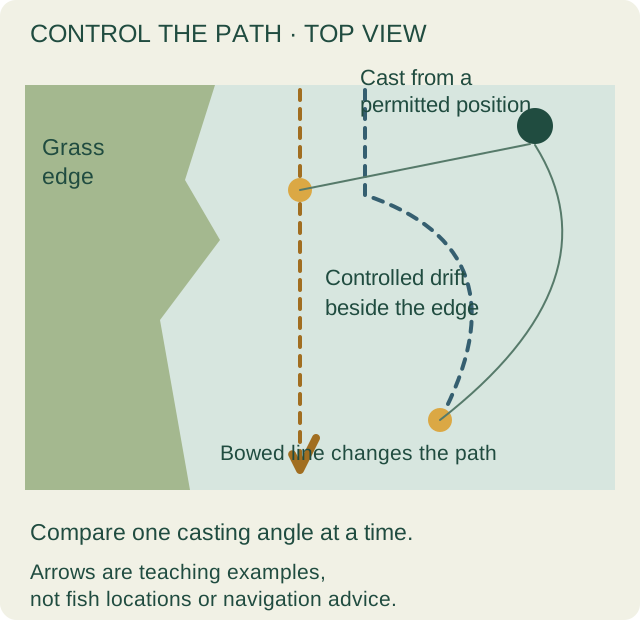
Beside a grass edge, cast into open water rather than into the plants. If the drift carries the rig toward the grass, retrieve it before the hook reaches it. Aim the next cast farther into clear water or change its direction.
Your line can alter that path too. Excess line can form a curve called a bow. Wind or water pushing the curve may pull the cork sideways.
 Open the full-size illustration →
The drawing separates water carrying the float from line pulling on it. It is a teaching example, not a fishing-location or boat-route map. Keep the cast short enough to follow both the cork and the line.
Cast, settle, move and pause
Check the space above, behind and beside you for the whole hanging rig. Make a smooth cast you can control. On a boat, use the position and direction identified by the crew.
- Let it settle. Give the bait or lure time to hang below the cork.
- Take up excess loose line. Wind gently while watching the float; stop before towing it toward you. A small rod movement needs to reach the cork rather than disappear into loose line.
- Give a short pull. Move the rod tip enough to disturb the surface, then ease off. Make a brief movement rather than dragging the cork continuously.
- Watch the pause. Let the bait or lure settle again. Look for a dip, sideways movement or disappearance instead of rushing to make another splash.
- Repeat or retrieve. Continue while you can follow the path. Bring the rig back if it tangles, reaches an obstruction or moves beyond your control.
There is no single pop count or pause length for every outing. Begin with a movement you can repeat. On a later cast, compare a different pause while keeping the rest of the sequence the same.
Watch the pause, not just the splash
A sudden dip in open water differs from the cork being steadily pulled into the same grass patch. Neither proves by itself that you have a fish: a snag, excess weight or moving water can also pull the float under.
The response to a bite depends on the hook. With a circle-hook bait setup, let a steady pull develop and wind as instructed rather than snapping the rod back. A J-hook setup can call for a deliberate rod movement, but not a large jerk for every dip. The hook-shape lesson explains the difference. Learn the response for the complete setup before fishing.
With live bait, retrieve periodically and inspect it. Surface movement does not tell you whether the shrimp is still properly attached or the hook has tangled below the cork.
Fix the problem you can see
- A rod movement barely reaches the cork: take up excess line without towing the float. Compare a shorter cast if you still cannot control it.
- Each pull drags the cork a long way: reduce the rod movement, then pause and watch it settle.
- The hook wraps around the cork: retrieve, untangle and check the hanging rig. Try a shorter, smoother cast.
- The hook returns covered in plants: clear it and try a path farther from the grass. If it still reaches vegetation, review the leader length.
- The cork keeps leaving your intended path: look for a bow in the line. Take up excess line, then compare a shorter cast or a different direction.
Change one thing at a time. If a shorter cast lets a small pull reach the cork, repeat that distance before trying farther. If a different path brings the hook back clear of grass, keep that path while learning the movement. Those are useful improvements even before catching a fish.