
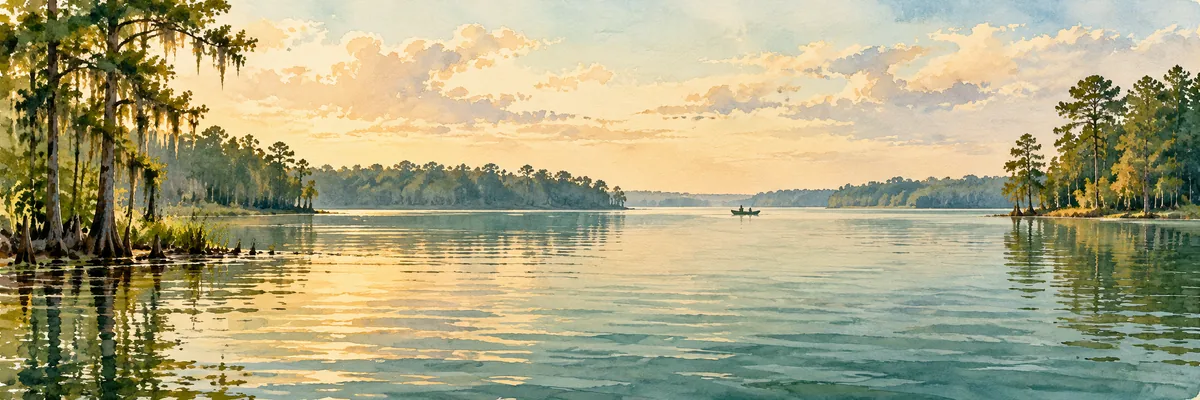
Toledo Bend is a reservoir on the Louisiana–Texas border. A reservoir is a lake formed by holding water behind a dam. Its size and two-state setting make the actual access point important when planning a visit.
Start with a permitted shore position, your own craft or a particular guided service, then identify the side and exact meeting/access point. Those are different visits to the same reservoir. Keep the actual activity and water with the directions, requirements and quote rather than assume the destination name settles them.
Picture what you'd like to learn
A bass-focused lesson may involve casting artificial lures. A lure is an object used to attract fish. Casting sends it out with the rod; the retrieve brings it back with the line and reel.
A crappie outing may use bait or a small jig, which combines a weighted head and hook. You might cast it or lower it beneath the boat to a chosen level. Have the guide show how to let line out, stop it and bring it back. A different fish name doesn't tell you which of those jobs you'll do.
Describe what each guest wants to do: repeated casting, lowering and watching a setup, taking turns or observing with breaks. Ask for the actual boat, riding/fishing/rest positions and how instruction is shared. A bass or crappie label identifies a target, not how many supervised attempts each guest receives.
For a hypothetical first lesson, request one complete demonstration: the parts and reel controls, release and stop, cast or lower, wait or move, bite response and retrieval. Retrieval means bringing line back with the reel. Agree who handles bait, tangles, landing and hooks before repeating the sequence. This is a learning request, not a service already confirmed.
Understand the lake features people mention
The Texas Parks and Wildlife lake profile describes timber, brush and channel habitat.
Cover means objects or plants associated with the water. Structure means bottom shape, such as a channel edge or slope. They can occur together, but a tree on the surface doesn't tell you the depth beneath it.
Ask: “Which feature can we identify, what depth information do we actually have and where should this bait travel?” Seeing timber or brush does not establish bottom depth, fish position or an unobstructed line path. Keep each answer or unknown separate.
With suitable instruction, compare a manageable presentation and inspect what returns before changing several parts. A hook carrying plants or line pulled away from the landing point gives a specific question about the path, not proof of where fish are. The cover-and-structure lesson explains objects and bottom shapes without making them interchangeable.
Choose the side and exact access
South Toledo Bend State Park is an official Louisiana-side starting point for researching a launch or stay. Check the facility and current arrangements for your intended activity.
A provider’s private or marina pickup can be elsewhere. Keep departure state/side · named marina or launch · actual boarding point · address/pin · arrival/departure/return · contact together. A marina name can still leave its gate, parking and dock unresolved. Obtain the actual instructions before connecting a room or transport booking.
Keep the meeting point distinct from the proposed fishing water. Launching on one side is not a complete description of where fishing, travel or bringing a catch ashore will occur. Have the provider or operator describe those parts rather than infer them from its business address.
For shore fishing, identify a permitted position and the approach both ways, hours, charges, facilities and room to use the method. A launch symbol or park stay does not establish bank-fishing permission or usable space. For your own craft, retain actual launch/parking/return and separate operating preparation; the reservoir profile is not a route or current-access instruction.
Read the border-water conditions
Reciprocity means recognition of a license under an agreement. It doesn't automatically cover every person, shoreline or connected water in the same way.
Read the official border-water guidance using the actual people, license held, date, water and shore/boat activity. Keep where you will fish, pass through and bring a catch ashore with the question. A departure side or another guest’s license is not the complete answer.
Record the source, applicable period and any exception or unresolved detail. Then resolve species identification, measurement, keeping and other catch conditions separately. The border-water lesson explains why a personal-license answer does not settle every catch question. A changed water, activity or date needs its affected answers revisited; this page does not announce current reciprocal privileges or limits.
Build the day around the actual offer
Toledo Bend guide information and Living the Dream are places to ask about a guided day. Confirm their current offer for your group and date before planning around it.
For a guided option, keep the actual method/teaching, all guests, boat/departure, hours, full-group quote, supplied versus included/extra gear/fuel and change terms together. Count observers and children; price coverage and allowed passengers are separate figures. Add collection/packing, credited advances, remaining payments and transport rather than treat docking as the end of the visit. The guide-selection article follows that conversation.
For any format, keep one current note: exact meeting/access, requirements answered or open, chosen setup/helper, shared supplies, arrival/return and the change contact. A saved lake photograph or provider reference is not a confirmation for that visit.
If bringing your own boat, prepare the launch and return as well as the fishing. Follow the clean, drain and dry guidance for wet equipment before taking it to another waterbody.