
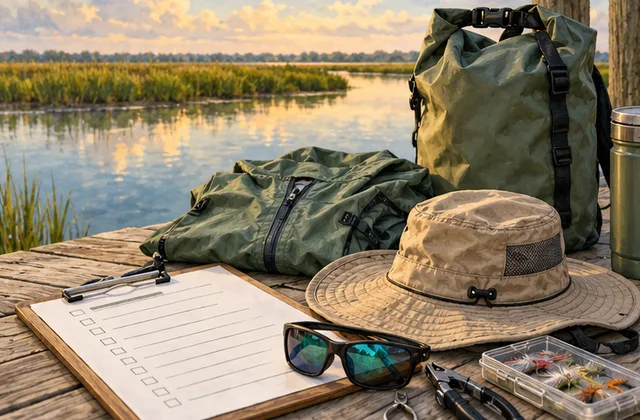
Start with the supplies confirmed for your trip, then pack what you'll use during the hours away. A guided trip may include fishing gear; if you're arranging the fishing yourself, organize the equipment as well as your personal bag. That can include gear you've borrowed, not just things you own.
Check rods, bait, food, drinking water, ice and cooler space separately. For each, record who arranges it, whether its cost is included or extra, where it will be stored and when it is needed. ‘Supplied’ and ‘included in the price’ answer different questions. Keep an unanswered item on the question list rather than treating it as supplied.
For a hypothetical guided day, the group might arrange one shared food bag, personal layers in small bags and a catch cooler at the return point if the provider confirms that arrangement. That is an example of dividing jobs, not a standard packing allowance. The actual boat, site, group and activity decide what can be brought and where it goes.
A practical personal bag
For the outing you've planned, consider:
- Sun protection: a hat, sunglasses and sunscreen.
- Clothing layers: something warmer and a rain layer if the weather and exposure call for them. Keep a dry change where you'll need it.
- Drinking water and food: whatever isn't supplied, packed in a way the boat or access location allows.
- Phone, keys and wallet: protect them from water and store them securely. Save the meeting address, arrival time and trip contact somewhere you can find without searching through a group chat.
- Required license or records: in the form the responsible agency accepts for your situation.
- Personal necessities: any items you need during the hours you'll be away. Discuss storage or assistance arrangements privately if needed.
Choose a bag you can carry along the actual approach and stow without blocking the boat’s floor area—the deck—or a walkway. Arrange help for bags privately where needed. Put water, a layer and other items needed during the outing where the crew or site arrangement lets you reach them without unpacking everything. Ask which storage is dry and how to protect its contents; a compartment is not automatically waterproof.
Dress for the whole outing
Start with comfortable clothes you can move in and don't mind getting wet or dirty: a shirt, shorts or trousers suited to the weather, secure footwear and a hat. Think about arrival, waiting, the ride, fishing and the return, not just the afternoon temperature.
Longer sleeves and trousers give more skin coverage; choose fabrics you can comfortably spend time in. Sunglasses, sun protection, shade and breaks are useful parts of the plan. Polarized lenses reduce reflected glare; check ultraviolet-light protection separately. UPF is a clothing label about ultraviolet protection. Read the product's own description and use sunscreen according to its directions.
Pack a layer you can add for a cool or windy ride and reach without unpacking everything. A rain jacket keeps rain off; a warm layer addresses cold, and one item may not do both. Try the rain layer over your clothes and check that your arms can move comfortably. Spray is water thrown up by wind or the boat's movement, so clothes can get wet without rain.
Ask about the boat's footwear rules before buying shoes. Nonmarking describes a sole designed not to scuff a surface; it doesn't tell you its grip. Consider the walk from parking too: a muddy bank, pier and boat deck are different surfaces.
Wading means entering the water to fish. Don't buy waders just because an outing mentions shallow water; first ask whether you'll enter it and what equipment and instruction are provided.
For children, confirm properly fitting life jackets and sizes separately; ordinary clothing isn't flotation equipment. Keep a spare change in suitable dry storage, using its closure as instructed. Decide whether you'll need it aboard or only afterward, and ask where you could change before driving home.
Check before bringing bulky extras
Before loading your own rods, large cooler or bulky food containers, describe their size and purpose to the provider or access manager. Ask what can come, how it will be carried and where it fits. An item needed only after fishing may belong at the return point if storage is suitable; something needed during the trip must remain available when you need it.
Do not solve duplicate supplies by assuming someone else has them. Put a responsible person beside each shared item, including drinking water and rubbish bags. If the answer changes, tell the group before everyone packs the earlier list.
A rod is the pole you hold; the reel attached to it stores and winds the line. Bait is something such as a worm or shrimp on a hook; lures are artificial items used to attract fish. Confirm what is already provided before buying or loading your own kit.
For an independent shore trip, add the rod and reel, the chosen hook-and-line setup, bait or lures, spare parts you know how to fit, line-cutting tools and a container for rubbish and clipped line. Prepare the landing or catch-care equipment your chosen fishing needs before leaving. The setup guide explains the fishing parts.
Taking your own boat or kayak also needs separate preparation for that craft and route. This personal-bag list doesn't replace it.
Confirm the equipment, help and extra charges
Tackle means fishing equipment, often the small parts such as hooks, weights and floats. Ask which parts suit the actual activity and are supplied. A rod aboard does not establish its suitability or the instruction: ask which method it fits, who shows the reel controls, who helps with bait and hooks, and how the bite response is taught. Check any lost-or-damaged-equipment charge before bringing your own instead.
Check food, drinking water, ice and cooler space individually. Ice for the boat's fish box doesn't necessarily include cold drinks or space for a guest cooler. Give the crew the full guest group and ask which life jackets are supplied, how fit is checked and what anyone must arrange.
Mark fuel, bait, meals, cleaning and other services as included, extra, guest-arranged or unanswered. For variable charges, ask how they're calculated. Check personal licenses separately through LDWF; ‘all included’ doesn't settle each person's requirements.
For a lake or river visit
Freshwater means water with little salt. Choose your actual bank, pier, launch or guide meeting point and save parking, arrival/opening hours and the expected return. Count children and people who won't fish, check current access and weather, and agree what happens if the plan changes. For river-connected water, a gauge measures height at a station, not depth at your fishing position.
Check the license for each person, then the water, intended fish and equipment. A site fee or another guest's license isn't the answer for everyone. Border-water arrangements need a check for that named water and activity. Use the license guide and water-boundary guide.
With a guide, confirm supplied gear, practice turns and who handles hooks. From shore, learn one complete arrangement before relying on it; the freshwater-rigs guide explains float and other setups. Prepare landing and hook-removal equipment, with help for jobs you haven't learned. For your own craft, include launch, route and return arrangements alongside its separate preparation.
Plan for the trip home
Keep during-trip supplies distinct from after-return supplies. If spare clothes, a towel or a catch cooler will only be used afterward, they may stay at the agreed return point if storage is suitable. Confirm that the trip actually finishes there and that the person collecting the items can reach them. A cooler left in a vehicle is not an arrangement for cold transport until suitable ice and storage are also organized.
Sort the final list into four groups:
- Bring during the trip: personal items and shared supplies assigned to you.
- Confirmed supplied: items you won't need to duplicate; note any separate charge.
- For the return: clothes, towel or catch cooler left at the agreed return point if suitable.
- Still to ask: anything not confirmed. Don't treat it as supplied yet.
For every shared item, keep responsible person · bring or supplied · location · needed time · cost question in the notes. For example, ‘Shared food bag: assigned to one group member, allowed storage to confirm’ leaves the unresolved part visible. This is a sample note, not an assigned real person. Leave room to carry rubbish and trimmed line back out.
If keeping fish, confirm what cleaning and packaging mean, any charge, when collection is ready and who supplies the travel cooler and ice. Fillets are pieces cut away from the backbone; cleaning doesn't supply every step of getting fish home. The fish-cleaning guide explains the handoff.
Allow for collection, unloading and payment after fishing. If releasing fish instead, agree who handles landing and unhooking before starting; catch preparation is a separate job from packing a personal bag. Assign wet-gear cleanup before the next water, using the clean, drain and dry guide.
Before leaving, compare the list with the actual place, boat, forecast and full time away. Everyone needs the meeting point, their assigned supplies and the change contact. Revisit affected clothing, equipment, storage and transport if the plan changes. Use the checklist to mark reviewed jobs and trip notes for names, times and unanswered details; old ticks are not confirmation of a new outing.
Sources: LDWF license information, recreational fishing guidance, Coast Guard boating information, Paradise preparation information and VooDoo's FAQ. Confirm the packing arrangements with your provider or access manager.