
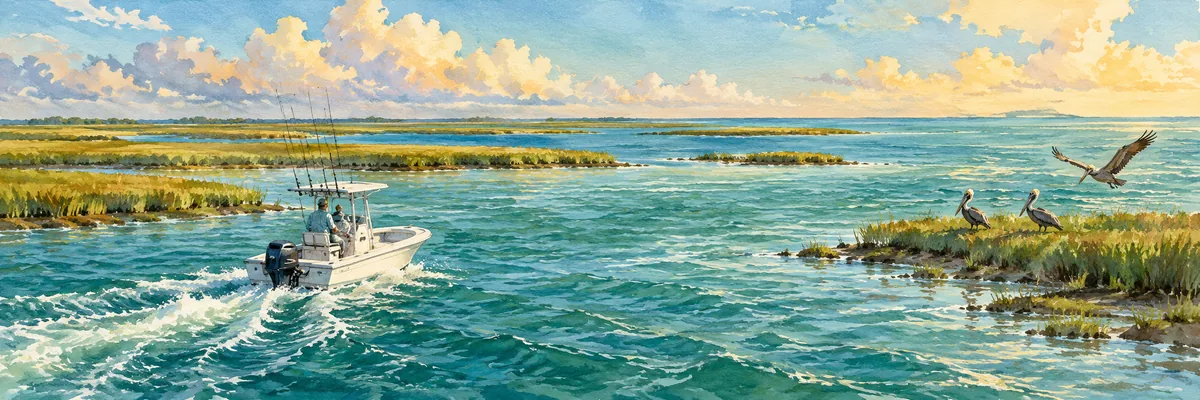
Calcasieu Lake, also called Big Lake, is a coastal fishing area in southwest Louisiana. The word “lake” doesn't make it the same kind of outing as an inland freshwater reservoir.
Choose whether you want to fish from shore, bring your own boat or book a guide. Each needs a specific access or meeting point; a search for Big Lake doesn't settle where to go. A lodge package also needs its boat, rooms and meals understood separately before you compare its price with another outing.
Understand the coastal setting
Coastal lakes connect with other waterways and can have a mixture of fresh water and seawater. That mixture is called brackish water; salinity means how salty it is.
Conditions can differ across a connected area and change over time. Treat salinity as a question about the particular water and time, not a single permanent description of every part of Big Lake. A fish list or photograph does not measure the conditions at your planned position.
Check the fish and activity you have in mind when choosing equipment or looking up requirements. The license requirements aren't decided by the lake's name or how salty the water is. The brackish-water explanation introduces that distinction, while the license guide explains Louisiana's separate official saltwater-line question.
Ask what kind of boat day is proposed
An inshore outing usually uses coastal lakes, marshes or bays. A nearshore outing goes into coastal waters relatively close to land. They can involve different boats, rides and methods; “Big Lake package” does not establish which experience is included.
You might cast a lure, an artificial object used to attract fish, or use bait or a lure below a float, a surface marker with the hook suspended below it. With a lure fished without a float, winding line back with the reel controls part of its movement. That return is called the retrieve. Ask for a demonstration of the actual setup, cast, movement or pause, response to a bite and return.
For an illustrative beginner comparison, make a manageable cast from an agreed position with suitable help. Follow the line or float after it lands and bring it back before an obstruction. Inspect for plants or tangles, then compare one shorter or clearer cast using the same setup. This tests a path question; it does not measure bottom depth or establish where fish are. The inshore-methods lesson explains the different activities.
Ask how supervised attempts, turns and help with bait, tangles, landing and hooks work. Describe all guests and their needs for boarding, riding, fishing and breaks. A rod supplied to each guest does not establish individual teaching or simultaneous fishing positions.
Hackberry Rod & Gun's information describes inland/coastal and nearshore services. Use it to investigate that provider's actual offer rather than assuming every package has the same route or target. This reference does not confirm current availability for your date.
Keep Lake Charles, Hackberry and the dock clear
Lake Charles is a regional reference point, while Hackberry is the base described in the provider information above. Neither broad name replaces the boarding instructions for your trip.
Get the assigned meeting point, entrance, parking, requested arrival and contact before arranging a transfer or room. A business address and the place you step onto the boat can be different. Keep arrival separate from boat departure, and give the driver the current boarding directions.
If you're arranging the outing yourself, identify the particular shore site or boat launch and the organization that manages it. Check the permitted activity, notices, approach, hours and return arrangements before planning around it. A guide's departure dock doesn't establish public fishing or launching access there. An own-boat outing also needs its own craft, route and current-information preparation; it cannot borrow the guide's operating plan.
Read a lodging package as a complete offer
Lodging means the accommodation where you'll stay. If a package mentions a lodge, write down the nights, rooms, meals and fishing days it includes. Count people staying separately from people fishing if those groups differ.
Ask whether the price is per guest, per boat or for the whole package. For a per-guest package, find the total for everyone coming; for a boat quote, check how many people it covers. Confirm room occupancy and how an extra room, observer or additional boat is charged. Compare the same people, nights and fishing days, showing any difference rather than hiding it in a per-person figure.
Confirm bait, tackle, fuel, food, instruction and cleaning individually. Tackle is fishing equipment. Mark each requested item as included, extra or unanswered. “Available” and “included in the price” aren't the same answer. Keep the full charge, credited deposit, payments and remaining amounts separate.
Match check-in and checkout to requested boarding arrival, expected dock return and fish collection. Ask about early meals, bags after checkout and cold storage instead of assuming the lodge handles all three. Establish who handles each booking and how a changed fishing date affects the room and meals. The lodging guide follows those separate arrangements.
Prepare for the outing and return
Open coastal water still needs the appropriate wind-and-wave information. Match its area and valid hours to the planned departure, fishing and return; a town temperature is not the whole water forecast. Ask how the guide communicates the next decision and what the booking terms say about cancellation or a changed boat, route, activity or duration.
Keep both rides, moves and breaks within the boat schedule, then add unloading, payments and any collection before road travel. A changed service needs its guest positions, teaching, price and stay arrangements checked again.
Resolve personal fishing and catch requirements for the actual people, water, date and activity, and agree release or lawful keeping. For kept fish, assign handling, cleaning, charges, collection and cold transport. If staying overnight, confirm where fish can be stored until leaving the accommodation and who collects them. Expected dock return is not the same time as readiness to drive home.