
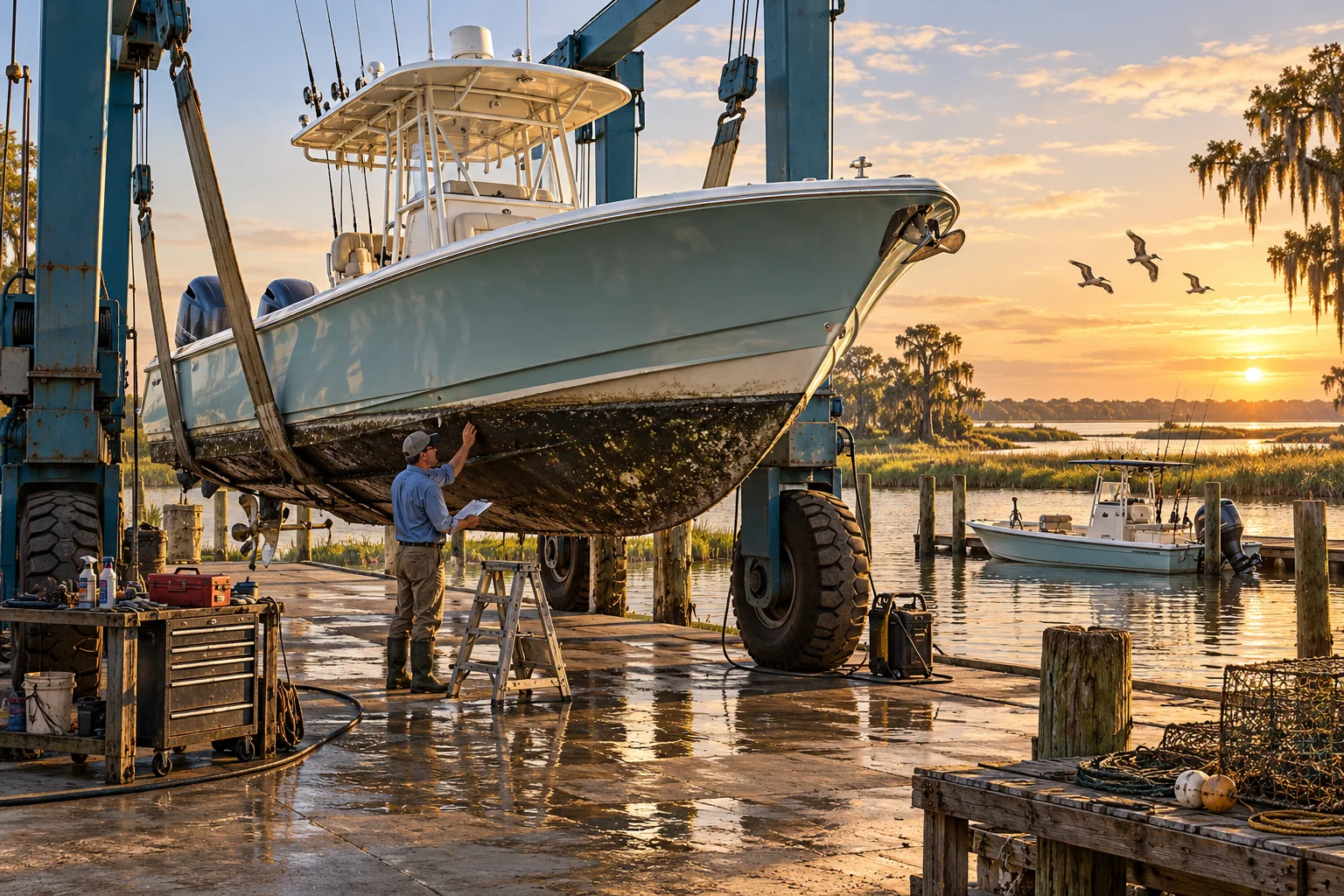
A working charter boat has to support the actual service, not just look appealing in a listing. Start with the guests, water, fishing activity, time away and departure point. Then compare candidate boats against the same description.
The hull is the boat's main body. Use a short service description to compare its guest spaces, condition, permissions, working arrangements and costs. Keep each answer labeled as documented, proposed or still to check rather than let a listing photograph settle the comparison.
Picture the guests and the work
Walk through how guests would get aboard, find a seat, move around, fish and use the bathroom or other facilities. Discuss everyone riding and the equipment, fuel, ice and catch with qualified people. The number of visible seats does not tell you what a loaded boat can safely or legally carry.
For a lesson-oriented outing, ask where the instructor can stand and how a beginner learns without loose hooks or rods obstructing boarding. For a longer boat day, investigate seating, shade, toilet arrangements and the actual time away.
Separate must-have conditions from preferences. For example, a roof over the helm doesn't establish shade where a beginner will fish, and a cabin photograph doesn't show the route to its guest facilities. Trace boarding, riding, fishing, breaks and return for the people you intend to serve. Resolve essential mismatches before weighing optional equipment or appearance.
Learn the size and range words
Draft is how far the boat extends below the water surface with a stated load. The waterline is where the surface meets the hull. Draft helps you ask about shallow access; it does not confirm the depth or clearance along a route.
Range is how far a boat can travel under specified conditions. A fuel tank's size alone does not tell you that distance. Ask about actual fuel use with the planned load, the route and conditions, and the fuel kept back as a reserve. These questions need answers for the particular boat and service.
Discuss those questions for the actual boat and service. This page does not supply a universal weather, loading, fuel-reserve or safe-distance rule.
Check what the boat is allowed to do
Registration or documentation, ownership, paid-passenger use and fishery permits have different purposes. Ask about the actual boat, owner, captain, waters and service rather than relying on a similar boat's history.
Where a boat was built and which commercial uses it qualifies for can also matter. MARAD is the U.S. Maritime Administration. Its small-vessel waiver deals with a specific question about where a boat was built. It does not settle inspection, crew, fishing permits or insurance. Take unusual ownership or build circumstances to the responsible source.
The permit introduction explains why a seller's permission cannot simply be assumed to follow the hull.
Understand a survey and sea trial
A survey is an examination of the boat within an agreed scope. Ask what the surveyor will inspect, what is excluded and which machinery or systems need a separate specialist. An independent survey provides an assessment separate from the seller's description.
A sea trial is an on-water evaluation. Have qualified people plan what should be assessed for the proposed service and appropriate conditions. A short, lightly loaded demonstration is not automatically representative of the daily work.
Compare the inspection findings with maintenance records. For each problem, ask what work is needed, what it would cost, whether parts are available, how long the boat would be unable to run trips and how the finished work would be checked. Give unresolved findings a responsible person and the evidence needed before relying on the boat for the proposed service. A report or repair invoice does not guarantee that every future failure has been prevented.
Keep the survey's scope and exclusions with the findings. A system needing a separate specialist remains an open question even if the general report is complete. Update the repair, downtime and cash assumptions when further findings arrive rather than carry the listing's ready-to-work claim into the plan.
Check the actual place the boat will work from
Ask the dock or property manager about the proposed commercial pickup, guest waiting area, parking, fuel, cleaning, storage and hours. A map pin or recreational slip listing does not settle that use.
A slip is the particular space where a boat is tied up at a dock or marina. Changing that place can change the ride, fuel, guest directions and work arrangements. Check the actual agreement for the departure site you plan to use; a nearby marina is not automatically an agreed substitute. Keep an enquiry about space separate from an agreed place to work, including the use and hours actually discussed.
Compare more than the monthly payment
List initial cash, any finance payments, inspection and repair work, equipment, insurance, dock/storage, maintenance and money held back for disruption. Record what each amount covers, its source and when it falls due. Keep estimates and unknowns identified, including work not covered by the first inspection or quote.
In an invented example, a $120,000 boat with a $30,000 down payment is not automatically a $30,000 startup. Other work and operating cash can still be needed. Avoid counting the full purchase price and financed payments as duplicate costs in the same comparison.
Use the vessel-survey worksheet and boat-payment tool to organize questions and assumptions. They do not approve condition, borrowing or a purchase.
Plan for time off the water
Write what happens if a repair stops the boat or the departure site becomes unavailable. Who informs guests, handles customer money and investigates an actual authorized substitute? Carry the same disruption through the repair, dock, insurance and payment questions so each part refers to the same period off the water.
Compare buying, leasing or partnering under the same weaker period and repair assumptions. Finish the candidate comparison with the essential fit, supporting documents, priced or unknown work and next question for each boat. Revisit the affected answers after a changed boat, service or departure point before relying on an earlier conclusion.